Social Media Search engines is no longer just a place to connect with friends or share updates. In 2026, platforms like Instagram, TikTok, YouTube, LinkedIn, and Pinterest have become powerful search engines where people discover products, services, and information every day.
Instead of relying only on traditional search engines like Google, users are now searching directly on social media to find recommendations, tutorials, reviews, brands, and solutions to their questions. This shift has created new opportunities for businesses and creators to reach people at the exact moment they are looking for something.
What Is Social Media Search?
Social media search is the process of finding information, products, services, creators, or brands directly through social media platforms instead of using traditional search engines like Google. Users search using keywords, hashtags, locations, or even voice queries to discover relevant content.
Unlike traditional search engines that mainly rank websites, social media platforms prioritize engaging content such as videos, images, reels, posts, and live discussions. Their algorithms analyze user interests, engagement, watch time, and search intent to deliver the most relevant results.
For businesses, social media search has become an essential marketing strategy because consumers increasingly rely on platforms like TikTok and Instagram to research products before making purchasing decisions.
Why Social Media Is Becoming the New Search Engine
The way people search online has changed dramatically over the last few years. Instead of opening Google first, many users now search directly on their favorite social media platforms.
Several factors have contributed to this shift:
Changing User Behavior: Modern users prefer visual and interactive content over long web pages. Watching a 30-second video often provides faster answers than reading an entire article.
AI-Powered Recommendations: Artificial intelligence helps platforms understand user interests and display personalized content. Even without following an account, users can discover valuable posts through recommendations.
Creator Trust: People often trust creators who share real experiences, tutorials, and product reviews. Authentic recommendations feel more reliable than traditional advertisements.
Zero-Click Discovery: Users can discover everything they need without leaving the platform. They can watch reviews, compare products, read comments, and even make purchases within the app.
How Social Media Search Works
Every social media platform uses algorithms to determine which content appears in search results. Although each platform has its own ranking system, several factors remain important across all networks.
- Keywords: Keywords are one of the strongest ranking signals. Including relevant keywords naturally in captions, titles, profile descriptions, and video descriptions helps platforms understand your content.
- Hashtags: Hashtags help categorize content and improve discoverability. However, using a few highly relevant hashtags usually performs better than adding dozens of unrelated ones.
- Captions: Well-written captions provide context for both users and algorithms. Descriptive captions containing natural keywords increase the chances of appearing in search results.
- On-Screen Text: Platforms can read text displayed inside images and videos using OCR (Optical Character Recognition). Adding clear, keyword-focused text overlays can improve discoverability.
- Spoken Keywords: Many platforms now analyze spoken words in videos. Mentioning important keywords naturally while speaking can strengthen your content’s search relevance.
- Engagement Signals: Likes, comments, shares, saves, watch time, and profile visits all indicate content quality. The higher the engagement, the greater the likelihood that your content will rank in search.
Best Social Media Search Optimization Tips
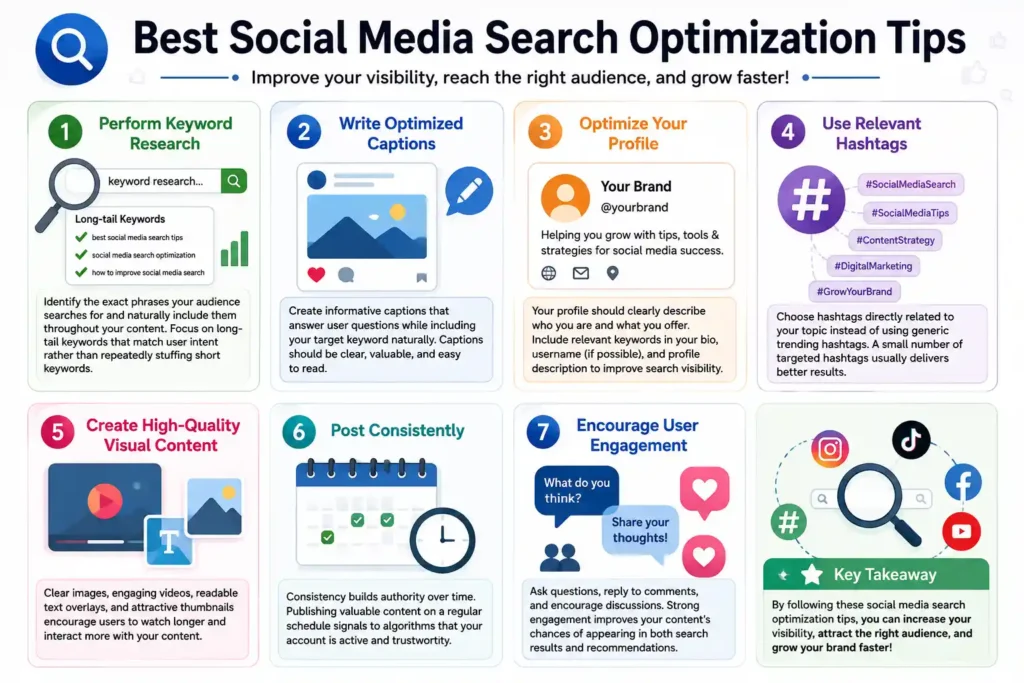
Optimizing your content for social media search—often called Social SEO—helps increase visibility and reach the right audience.
Platform-Specific Social Media Search Strategies
Every social media platform has its own search algorithm. Understanding how each one works can help you reach a larger audience and improve your content’s visibility.
-
Instagram Search: Instagram ranks content based on keywords, captions, hashtags, engagement, and user activity. Add your target keyword naturally in your caption, include descriptive alt text when available, and create engaging Reels to improve discoverability. Consistent posting and meaningful interactions also increase your chances of appearing in Explore and search results.
-
TikTok Search: TikTok has become one of the most popular search platforms, especially among younger users. Mention your primary keyword in the video, include it in the caption, and use relevant hashtags. Short, engaging videos with high watch time and strong audience interaction are more likely to rank in TikTok search.
-
YouTube Search: YouTube is the world’s second-largest search engine. Optimize your video title, description, thumbnail, and tags with relevant keywords. Organize videos into playlists and encourage viewers to like, comment, and subscribe to improve rankings.
-
Facebook Search: Facebook search considers keywords in posts, page information, and user engagement. Keep your business page complete, publish valuable content regularly, and encourage followers to interact with your posts.
-
LinkedIn Search: For professionals and B2B businesses, LinkedIn search is highly valuable. Use industry-specific keywords in your profile, company page, and posts. Share educational content and participate in discussions to increase visibility.
-
Pinterest and Reddit: Pinterest works like a visual search engine, making keyword-rich pin titles and descriptions essential. Reddit focuses on valuable discussions, so contribute helpful answers instead of promotional content to build credibility.
Social Media Search vs Google Search
Although both help users find information, they work differently.
Google mainly ranks websites based on SEO factors such as backlinks, page speed, and content quality. Social media platforms focus more on engagement, relevance, user behavior, and content freshness.
Google is ideal for detailed guides, research, and long-form information, while social media is better for quick answers, tutorials, product reviews, and real-time trends.
Instead of choosing one over the other, businesses should combine both strategies. A strong website supported by active social media profiles creates greater visibility across multiple search channels.
Common Social Media Search Mistakes
Even great content may fail to rank if you make common optimization mistakes.
-
Ignoring Keywords: Publishing content without researching keywords makes it difficult for search algorithms to understand your topic.
-
Keyword Stuffing: Repeating the same keyword too many times reduces readability and can negatively affect user experience. Always use keywords naturally.
-
Using Irrelevant Hashtags: Popular hashtags are not always the best choice. Focus on hashtags that are closely related to your content and audience.
-
Poor Content Quality: Low-quality images, unclear videos, or weak captions reduce engagement and limit your reach. Invest time in creating valuable, high-quality content.
-
Inconsistent Posting: Posting randomly makes it harder to build authority. Maintain a regular publishing schedule to keep your audience engaged.
-
Ignoring Analytics: Without tracking your performance, you won’t know which content performs best. Monitor key metrics such as reach, engagement, watch time, clicks, and conversions to improve future content.
Final Thoughts
Social media is no longer just a trend—it has become an essential part of digital marketing. As more people search directly on platforms like Instagram, TikTok, YouTube, LinkedIn, and Pinterest, businesses must adapt their strategies to remain visible.
By understanding how social media search works, using relevant keywords, optimizing your content, and staying consistent, you can improve your reach and attract the right audience. Combining Social SEO with traditional SEO creates a stronger online presence and helps your brand stay competitive in 2026 and beyond.
Frequently Asked Questions (FAQs)
1. How to check if a person is on social media?
You can search for a person’s name, username, email address, or phone number on platforms like Instagram, Facebook, LinkedIn, TikTok, and X. You can also use Google by searching their name along with the social media platform.
2. What is the best social media search tool?
The best social media tools include Google, Sprout, Hootsuite, Brand24, Mention, and Buzz Sumo. The right tool depends on whether you need profile searches, keyword tracking, trend analysis, or social listening.
3. Why is social media search important?
Social media search helps users discover relevant content, products, brands, and creators quickly. For businesses, it increases visibility, improves brand awareness, and drives organic traffic through Social SEO.
4. Which social media platform has the best search feature?
TikTok, Instagram, YouTube, and LinkedIn offer some of the most advanced search features. Each platform allows users to search by keywords, hashtags, profiles, and trending content.
5. Can social media search improve SEO?
Yes. While social media signals are not direct Google ranking factors, optimized social media content can increase brand visibility, attract backlinks, drive website traffic, and support your overall SEO strategy.