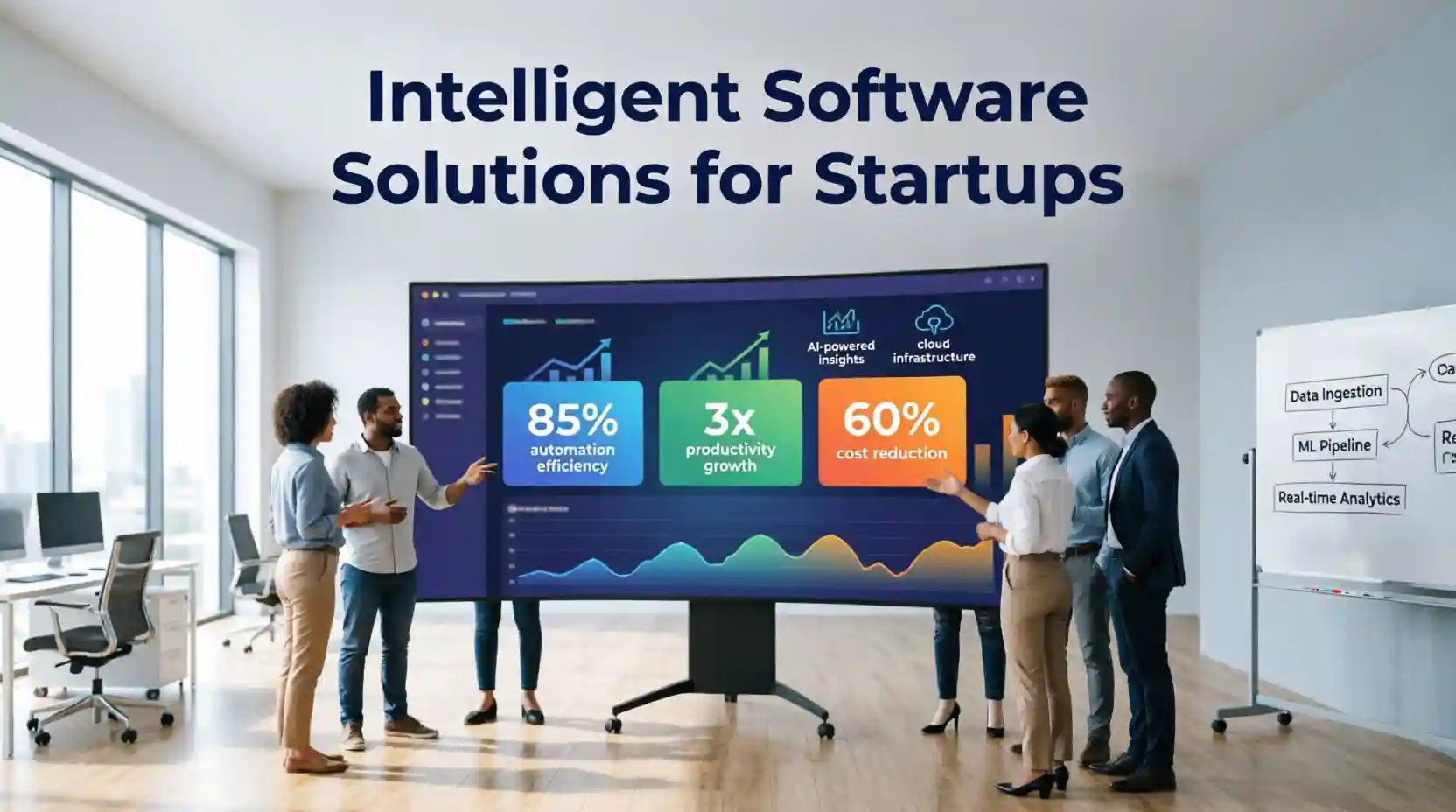
Intelligent Software Solutions for Startups are advanced digital tools that use artificial intelligence, automation, data analytics, and smart algorithms to help new businesses work faster and make better decisions. Unlike traditional software that mainly follows predefined instructions, intelligent software can analyze data, recognize patterns, automate tasks, and adapt to changing business needs.
For startups with limited budgets and small teams, these solutions can provide practical ways to improve productivity without requiring a large workforce. From automated customer support and intelligent document processing to business analytics and cloud-based platforms, startups can use smart technology across different areas of their operations.
What Is Intelligent Software?
Intelligent software combines technologies such as AI, machine learning, natural language processing, and data analytics to perform tasks that normally require human judgment or repeated manual effort. For example, an intelligent system can analyze customer behavior, identify trends, recommend actions, or automatically process large amounts of information.
For startups, this technology can make everyday operations more efficient while providing valuable insights for growth. Intelligent Software Solutions for Startups can also integrate with existing business tools, allowing companies to automate workflows and manage information from a centralized system.
Intelligent Software vs. Traditional Software
Traditional software generally works according to fixed rules and predefined commands. Intelligent software, however, can use data and AI to identify patterns, generate insights, and support more flexible decision-making.
For example, a traditional customer management system may store customer information, while an intelligent system can analyze that information to identify buying patterns and suggest personalized actions.
This difference makes intelligent software particularly useful for startups that need to adapt quickly, reduce repetitive work, and build scalable digital operations.
Why Startups Need Intelligent Software Solutions

Startups often operate with limited budgets, small teams, and rapidly changing business requirements. Intelligent software can help address these challenges by automating routine work, improving decision-making, and allowing teams to focus on higher-value activities. Instead of adding employees for every growing task, startups can use technology to handle repetitive processes more efficiently.
Automating Repetitive Business Processes
Manual tasks such as data entry, document processing, customer follow-ups, scheduling, and reporting can consume valuable time. Intelligent software can automate many of these activities and reduce the risk of human errors.
For example, an AI-powered system can extract information from invoices or documents, organize customer data, and automatically trigger specific workflows. This allows startup employees to spend more time on product development, customer relationships, and business strategy.
Improving Productivity and Decision-Making
Startups need to make fast decisions while dealing with limited information and resources. Intelligent software can analyze large amounts of business data and turn it into useful insights.
Business intelligence dashboards, predictive analytics, and AI-powered reporting tools can help founders understand sales trends, customer behavior, and operational performance. With access to timely information, teams can identify opportunities and respond to problems before they become larger issues.
Reducing Costs and Supporting Growth
Cost control is especially important during the early stages of a startup. Intelligent software can reduce the amount of time spent on manual processes and help businesses use their existing resources more efficiently.
Cloud-based and automated solutions can also support growth without requiring startups to immediately invest in extensive hardware or additional staff. As the business expands, scalable software can adapt to higher workloads and changing operational needs.
By combining automation, analytics, and scalability, Intelligent Software Solutions for Startups can create a stronger foundation for sustainable digital growth.
How Intelligent Software Solutions Drive Digital Transformation

Digital transformation involves using modern technology to improve how a business operates, serves customers, and makes decisions. Intelligent Software Solutions for Startups can accelerate this transformation by combining AI, automation, analytics, and cloud technology into everyday business processes.
AI-Powered Automation and Smart Workflows
Automation is one of the most important ways intelligent software supports digital transformation. AI-powered tools can handle repetitive workflows such as data processing, customer inquiries, scheduling, and reporting.
Instead of relying entirely on manual processes, startups can create smart workflows that automatically move information between different systems. This improves efficiency, reduces errors, and allows employees to focus on strategic work.
Data Analytics and Business Intelligence
Modern businesses generate large amounts of customer, sales, and operational data. Intelligent software can analyze this information and turn it into actionable insights.
Business intelligence dashboards can help startups monitor key performance indicators, identify customer trends, forecast demand, and make informed decisions. Predictive analytics can also help teams recognize potential opportunities or problems before they become difficult to manage.
Better Customer Experiences
Digital transformation is not only about internal operations. It also changes how businesses interact with their customers.
AI-powered chatbots, personalized recommendations, automated responses, and customer relationship management systems can create faster and more relevant experiences. Intelligent systems can analyze customer interactions and use those insights to improve future communication.
Cloud Integration and Scalability
Cloud technology allows startups to access software and business data without depending on extensive physical infrastructure. Intelligent cloud-based solutions can integrate different business functions while making it easier to scale operations.
As a startup grows, its software needs may change. Scalable cloud solutions can support additional users, larger amounts of data, and new workflows without requiring a complete replacement of the existing system.
Through automation, analytics, customer-focused technology, and scalable infrastructure, Intelligent Software Solutions for Startups can turn digital transformation into a practical growth strategy rather than simply a technology upgrade.
Types of Intelligent Software Solutions for Startups

Startups can choose from different types of intelligent software depending on their goals, industry, budget, and operational needs. The right solution can automate routine work, improve customer interactions, and provide useful business insights without creating unnecessary complexity.
AI-Powered CRM and Customer Support
AI-powered customer relationship management (CRM) software can help startups organize customer information, track interactions, and identify valuable sales opportunities. Intelligent chatbots and virtual assistants can also answer common questions and provide support around the clock.
By analyzing customer interactions and behavior, these systems can help businesses personalize communication and improve customer satisfaction.
Best Intelligent Document Processing Software
Document processing is another area where intelligent technology can save significant time. Best intelligent document processing software uses AI, optical character recognition, and machine learning to extract information from invoices, contracts, forms, and other business documents.
For startups, automated document processing can reduce manual data entry and improve accuracy. Instead of spending hours organizing documents, employees can focus on more important business activities.
Business Intelligence and Analytics
Business intelligence software collects and analyzes information from different sources to provide actionable insights. Startups can use dashboards to monitor sales, revenue, customer behavior, marketing performance, and other key metrics.
These insights help founders understand what is working and where improvements are needed. Predictive analytics can also help businesses forecast trends and make more informed decisions.
Workflow and Process Automation Software
Workflow automation tools can connect different business applications and automate repetitive processes. For example, a startup can create an automated workflow that captures a new customer inquiry, updates the CRM, sends a follow-up email, and notifies the sales team.
This reduces repetitive work while keeping business processes organized and consistent.
Cloud-Based Intelligent Software Solutions
Cloud-based software provides startups with flexible access to applications, data, and business tools from different locations. It can also make collaboration easier for distributed teams.
As the company grows, scalable cloud platforms can accommodate additional users and workloads without requiring major infrastructure changes. This makes cloud-based Intelligent Software Solutions for Startups a practical option for businesses planning long-term growth.
Key Benefits of Intelligent Software Solutions for Startups
For startups, every resource matters. The right software can help a small team accomplish more without adding unnecessary complexity or costs. Intelligent Software Solutions for Startups combine automation, analytics, and AI-powered capabilities to improve everyday operations and support sustainable growth.
Improving Productivity and Efficiency
Intelligent software can automate repetitive tasks such as data entry, reporting, scheduling, document processing, and customer inquiries. By reducing manual work, employees can spend more time on product development, strategy, and customer relationships.
Automation can also create more consistent workflows and reduce the possibility of human errors. This allows startups to maintain productivity even when their teams are small.
Scaling Operations With Intelligent Software
A startup’s technology needs can change quickly as its customer base and operations expand. Scalable software can support increased workloads, additional users, and new business processes without requiring the company to completely replace its systems.
Cloud-based platforms are particularly useful because startups can often adjust resources as their needs change. This flexibility helps businesses grow while keeping technology manageable.
Enhancing Security and Data Protection
As startups collect customer and business information, protecting that data becomes increasingly important. Intelligent security solutions can monitor systems, identify unusual activity, and help detect potential threats.
Features such as automated monitoring, access controls, encryption, and intelligent threat detection can provide an additional layer of protection. Strong security practices also help startups build customer trust and meet relevant compliance requirements.
Supporting Better Business Decisions
One of the major advantages of intelligent software is its ability to turn large amounts of data into useful insights. Analytics and AI-powered reporting can help founders track performance, understand customer behavior, identify trends, and evaluate business opportunities.
Instead of relying only on assumptions, startups can use real-time information to make more informed decisions and adjust their strategies when market conditions change.
Reducing Long-Term Costs
Although some intelligent software solutions require an initial investment, automation can reduce ongoing operational costs by minimizing manual work and improving resource utilization.
When repetitive tasks are handled automatically, startups can achieve more with existing teams and redirect resources toward activities that directly contribute to growth.
How to Choose the Right Intelligent Software Solution
Choosing the right software is important for startups because the wrong solution can increase costs, create integration problems, or become difficult to manage as the business grows. Before investing in Intelligent Software Solutions for Startups, founders should evaluate their current needs, future goals, budget, and technical requirements.
Scalability, Integration, and Security
Startups should choose software that can grow alongside the business. A solution should support additional users, increasing data volumes, and new workflows without requiring a complete system replacement.
Integration is equally important. The software should work smoothly with existing tools such as CRM platforms, accounting systems, communication applications, and analytics tools. Good integration reduces duplicate data entry and keeps business information connected.
Security should also be a priority. Look for features such as encryption, secure authentication, access controls, regular updates, and reliable data protection. If the software uses AI, understand how customer and business data is collected, stored, and processed.
Cost, Features, and Long-Term ROI
Price should not be the only factor when comparing intelligent software. Startups should consider the overall value of the solution, including its features, maintenance costs, training requirements, and potential return on investment.
A low-cost tool may become expensive if it lacks important features or requires frequent manual work. On the other hand, an advanced platform may offer more capabilities than a small startup actually needs.
Before choosing a solution, identify the specific problem it should solve and compare available options based on functionality, ease of use, scalability, security, and expected business value. Starting with essential features and expanding later can help startups control costs while adopting intelligent technology gradually.
Common Challenges With Intelligent Software Solutions
Although intelligent software can improve efficiency and support digital transformation, implementation does not always go smoothly. Startups may face budget limitations, integration issues, data concerns, or difficulties adapting to new technology. Understanding these challenges before implementation can help businesses avoid common mistakes.
Why Intelligent Software Solutions May Not Work as Expected
Intelligent Software Solutions for Startups may fail to deliver expected results when they are chosen without clearly defining the business problem. A sophisticated AI tool cannot solve an inefficient process if the underlying workflow has not been properly planned.
Poor-quality or incomplete data can also affect the accuracy of AI-powered systems. If software receives inconsistent information, its recommendations and predictions may be unreliable.
Another common issue is choosing a solution that is too complex for the startup’s actual needs. Employees may struggle to use advanced features, reducing adoption and limiting the software’s value.
Integration, Data, and Employee Training Challenges
Integrating new intelligent software with existing systems can be difficult, especially when a startup relies on several unrelated applications. Compatibility issues can create duplicate data, workflow disruptions, or additional technical costs.
Data security is another important consideration. Startups need to understand how software providers collect, store, and process sensitive information. Strong access controls and appropriate security practices should be established before implementation.
Employee training is equally important. Even the best software will provide limited benefits if employees do not understand how to use it effectively. Startups should provide practical training and allow teams enough time to adapt to new workflows.
To improve results, businesses should begin with a clearly defined problem, select software that matches their actual requirements, use reliable data, and introduce the technology gradually. Regularly reviewing performance can also help identify areas that need improvement.
Frequently Asked Questions
What Is Intelligent Software?
Intelligent software is technology that uses AI, machine learning, data analytics, or automation to perform tasks, identify patterns, generate insights, and support decision-making. Unlike traditional software, it can process information and respond intelligently to changing situations.
What Is an Intelligent Software Agent?
An intelligent software agent is a program that can perceive information, process it, and take actions to achieve a specific goal. For example, an AI customer-support agent can understand customer questions and provide automated responses based on available information.
What Are the 5 Types of Intelligent Agents?
The five commonly discussed types are simple reflex agents, model-based reflex agents, goal-based agents, utility-based agents, and learning agents. They differ in how they process information, make decisions, and adapt to their environment.
Is ChatGPT an Intelligent Agent?
ChatGPT can be considered an AI system with agent-like capabilities when it is connected to tools and given the ability to perform tasks. On its own, it primarily generates responses based on the input and context it receives rather than independently operating across an environment.
How Can Intelligent Software Solutions Help Startups?
Intelligent Software Solutions for Startups can automate repetitive tasks, improve customer experiences, analyze business data, strengthen security, and support faster decision-making. These capabilities can help small teams operate more efficiently while preparing for future growth.
Are Intelligent Software Solutions Affordable for Startups?
The cost varies depending on the software, features, number of users, and implementation requirements. Cloud-based and subscription solutions can make intelligent technology more accessible because startups can often begin with essential features and scale their usage as the business grows.
Conclusion
Intelligent software is becoming an important part of digital transformation, especially for startups that need to grow efficiently while working with limited resources. From AI-powered automation and business intelligence to cloud platforms, intelligent document processing, and cybersecurity, these technologies can improve how startups operate and serve their customers.
The key is not simply adopting the most advanced technology. Startups should choose Intelligent Software Solutions for Startups that solve specific business problems, integrate with existing systems, provide strong security, and offer enough scalability for future growth.