Amazon PPC Marketing Services help sellers promote their products, reach potential buyers, and increase sales through paid advertising. However, running successful Amazon ads requires more than choosing keywords and setting a daily budget. Sellers also need the right campaign structure, bidding strategy, product targeting, and regular performance analysis.
Amazon has millions of products competing for customer attention. Even a high-quality product can struggle to gain visibility without effective advertising. This is where professional Amazon PPC management becomes valuable. It helps businesses control advertising costs, attract relevant shoppers, and improve campaign performance.
What Amazon PPC Marketing Services Include
Amazon PPC (Pay-Per-Click) is an advertising model in which sellers pay when shoppers click on their ads. These advertisements can appear in Amazon search results, product detail pages, and other advertising placements.
Amazon PPC marketing services involve planning, creating, managing, and optimizing these advertising campaigns. The goal is to connect products with relevant shoppers while keeping advertising spending under control.
Professional service providers may handle several tasks, including:
- Keyword research: Finding search terms that potential customers use when looking for products.
- Campaign creation: Setting up campaigns and ad groups based on product goals.
- Bid management: Adjusting keyword and product-targeting bids to manage advertising costs.
- Budget planning: Allocating spending across campaigns according to performance.
- Negative keyword research: Excluding irrelevant searches that may waste advertising budget.
- Performance tracking: Reviewing clicks, sales, conversions, and advertising costs.
- Campaign optimization: Improving targeting and bidding based on campaign data.
These services can help sellers make informed advertising decisions instead of relying on guesswork.
How Amazon PPC Services Work
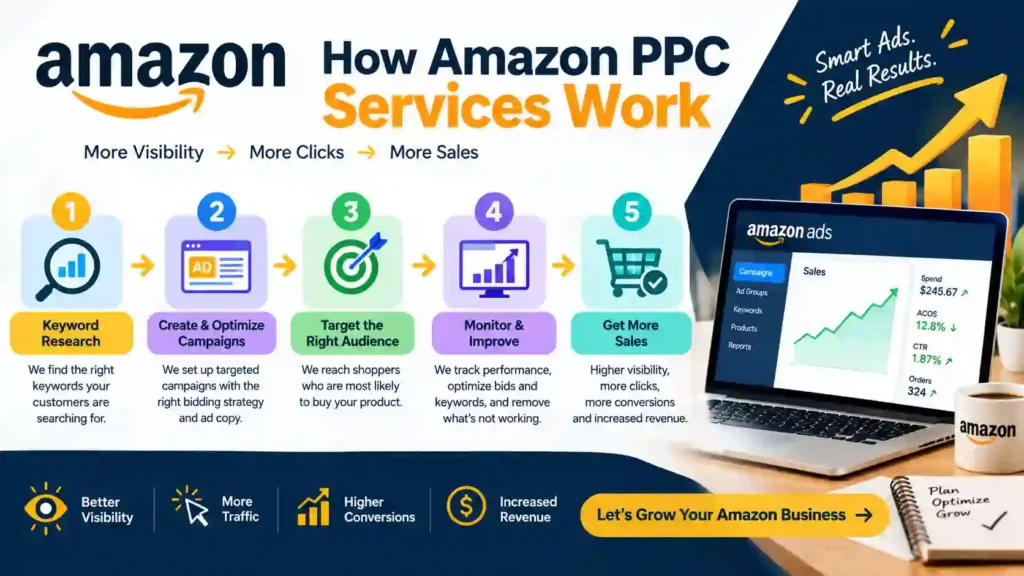
Amazon PPC management services follow a structured process. Each step helps advertisers reach the right audience and improve campaign results.
1. Product and Account Analysis
The first step is understanding the seller’s products, target customers, competition, and advertising goals. A service provider may also review existing campaigns to identify wasted spending, weak targeting, or missed opportunities.
This analysis helps create a strategy that matches the product’s price, profit margin, and market demand.
2. Amazon PPC Keyword Research
Keyword research helps advertisers identify relevant search terms that shoppers may use before purchasing a product.
For example, a seller promoting wireless headphones might target terms such as:
- Wireless headphones
- Bluetooth headphones
- Noise-cancelling headphones
- Headphones for travel
The best keywords depend on product relevance, competition, and campaign performance. Choosing relevant search terms can help ads reach shoppers who are more likely to make a purchase.
3. Campaign Setup and Targeting
After researching keywords, the next step is creating advertising campaigns. Sellers can use keyword targeting to reach shoppers searching for specific terms or product targeting to show ads on relevant product pages.
A properly organized campaign structure makes it easier to manage budgets, evaluate results, and adjust targeting when needed.
4. Bid and Budget Management
Bids determine how much an advertiser is willing to pay for a click. However, setting high bids does not automatically guarantee profitable sales.
Professional managers review campaign performance and adjust bids according to advertising goals. They may increase bids for valuable keywords or reduce spending on targets that generate clicks without meaningful results.
5. Continuous Monitoring and Optimization
Amazon PPC campaigns need regular attention. Managers review performance data, identify opportunities, add negative keywords, and refine targeting.
This ongoing process helps sellers understand which campaigns contribute to sales and which ones need improvement.
Benefits of Amazon PPC Marketing Services
Managing Amazon advertising can become complicated when a seller handles multiple products and campaigns. Professional management can provide useful support by combining advertising knowledge with regular campaign analysis.
- Better Targeting Through Amazon PPC Optimization: Effective targeting helps sellers connect their products with relevant shoppers. Amazon PPC optimization services focus on improving keyword selection, product targeting, bids, and campaign structure.
- Improved Advertising Budget Control: A planned budget helps sellers avoid unnecessary spending. Campaign managers review advertising costs and identify areas where budget adjustments may improve efficiency. They also monitor important metrics such as Advertising Cost of Sales (ACOS) and Total Advertising Cost of Sales (TACOS) to understand how advertising spending relates to sales.
- More Time for Business Operations: Running campaigns requires research, monitoring, and regular adjustments. Outsourcing these tasks can give sellers more time to manage inventory, improve product listings, handle customer service, and plan business growth.
- Data-Driven Advertising Decisions: Professional PPC management relies on campaign data rather than assumptions. Reviewing impressions, clicks, conversion rates, and sales helps advertisers understand what is working and where changes may be necessary. However, results depend on several factors, including product quality, pricing, competition, listing performance, and advertising budget. No service can guarantee a specific sales result.
Amazon PPC Advertising Types and Campaigns
Choosing the right advertising format is an important part of Amazon PPC marketing services. Amazon offers different ad types that help sellers reach shoppers at various stages of their buying journey.
- Sponsored Products PPC Campaigns: Sponsored Products are one of the most commonly used Amazon advertising formats. These ads promote individual product listings and can appear in search results and on product detail pages. Sellers can use automatic or manual targeting to reach potential customers. Automatic targeting allows Amazon to match ads with relevant searches, while manual targeting gives advertisers more control over keywords and product targets.
- Sponsored Brands Advertising Strategy: Sponsored Brands ads help sellers promote their brand, products, and storefront. Depending on the available ad format and eligibility, these advertisements may include a brand logo, custom headline, and multiple products.
- Sponsored Display Advertising Campaigns: Sponsored Display advertising helps sellers reach relevant audiences through product and audience targeting options. These ads can appear on Amazon and eligible placements beyond Amazon, depending on campaign settings and availability.
- Amazon DSP Advertising Options: Amazon Demand-Side Platform (DSP) provides programmatic advertising options for reaching audiences across Amazon-owned properties and third-party inventory.
Keyword Research for Amazon PPC Campaigns
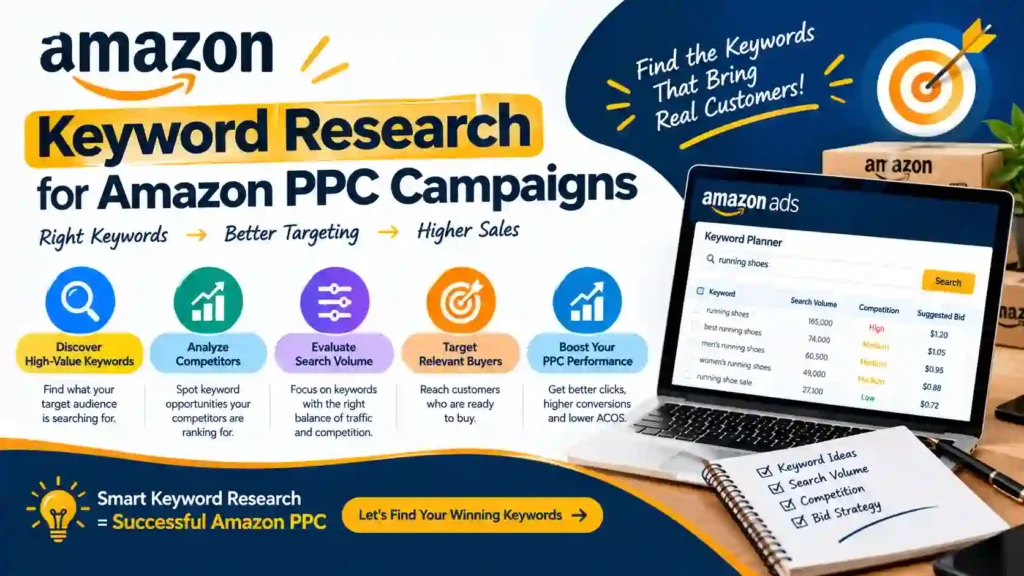
Keyword research plays a major role in successful Amazon PPC campaigns. Relevant keywords help advertisers reach shoppers who are actively searching for products similar to theirs.
Find High-Relevance Amazon PPC Keywords
Start by identifying search terms that accurately describe your product. Consider product features, materials, sizes, uses, and customer needs.
For example, a seller advertising a stainless-steel water bottle could research phrases such as:
- Stainless steel water bottle
- Reusable water bottle
- Insulated water bottle
- Leakproof water bottle
Choose keywords based on relevance and available performance data rather than search volume alone.
Use Automatic and Manual PPC Targeting
Amazon offers two main keyword-targeting approaches:
- Automatic targeting: Amazon uses product information to match advertisements with relevant shopping searches and product pages.
- Manual targeting: Advertisers select their own keywords or product targets and can manage bids for individual targets.
Automatic campaigns can help discover new search terms, while manual campaigns provide greater control over targeting.
Apply Negative Keywords to Reduce Wasted Spending
Negative keywords prevent ads from appearing for selected irrelevant search terms. For example, a seller advertising premium leather wallets may exclude searches related to free wallets or plastic wallets if those searches do not match the product.
Reviewing search-term reports can help identify terms that generate irrelevant clicks. Adding suitable negative keywords may improve targeting and reduce unnecessary advertising costs.
Amazon PPC Budget and Bid Optimization
Bidding and budgeting affect how advertising campaigns spend money and compete for ad placements. A strong management strategy balances visibility with profitability.
Choose the Right Amazon PPC Bidding Strategy
Amazon provides different bidding strategies, including dynamic bids and fixed bids, subject to campaign type and available settings.
- Dynamic bids – down only: Amazon may reduce bids when a click is less likely to convert into a sale.
- Dynamic bids – up and down: Amazon may increase or decrease bids based on the likelihood of conversion.
- Fixed bids: Amazon uses the bid amount set by the advertiser, with applicable placement adjustments.
The right option depends on campaign goals, product margins, and performance history.
Allocate Advertising Budget Across Campaigns
Avoid assigning the same budget to every campaign without reviewing its performance. Instead, consider product demand, profit margins, sales history, and campaign results.
For example, campaigns generating relevant traffic and profitable sales may deserve more budget, while underperforming campaigns may need adjustments.
Monitor ACOS and TACOS for Better PPC Performance
Two important metrics help sellers evaluate Amazon advertising:
- ACOS (Advertising Cost of Sales): Measures advertising spend compared with sales generated directly through ads.
- TACOS (Total Advertising Cost of Sales): Measures advertising spend compared with total sales, including organic sales.
ACOS formula:
ACOS = (Ad Spend ÷ Ad Sales) × 100
TACOS formula:
TACOS = (Ad Spend ÷ Total Sales) × 100
For example, if a seller spends $100 on ads and generates $400 in attributed ad sales, ACOS is 25%.
If the same $100 advertising spend contributes to $1,000 in total sales, TACOS is 10%.
These metrics provide useful insights, but they should be reviewed alongside profit margins, conversion rates, and overall business goals.
Advanced Strategies for Amazon PPC Optimization
Once campaigns start generating data, sellers need a clear optimization strategy to improve advertising performance. Regular testing and analysis can help identify opportunities without increasing spending unnecessarily.
Improve Product Targeting With Amazon PPC Services
Product targeting allows advertisers to display their products alongside relevant product listings and shopping categories. It can help sellers reach shoppers who are comparing similar products.
For better targeting:
- Select competing products that match your product category.
- Review the performance of individual product targets.
- Exclude irrelevant or poorly performing targets.
- Test different product groups to identify useful opportunities.
A focused product-targeting strategy can help attract shoppers with relevant buying interests.
Use Amazon PPC Automation for Campaign Management
Managing multiple campaigns manually can take considerable time. Automation tools and campaign rules can help sellers monitor performance and make routine adjustments.
For example, advertisers may use automation to:
- Adjust bids based on selected performance conditions.
- Monitor daily campaign spending.
- Identify keywords with rising advertising costs.
- Pause targets that meet predefined conditions.
- Generate regular performance reports.
Automation can improve efficiency, but it does not replace human analysis. Sellers should review automated changes to ensure they support their advertising goals.
Optimize Product Listings Alongside Amazon PPC Advertising
Advertising can bring shoppers to a product page, but the listing must convince them to buy. A weak listing may receive clicks without generating enough sales.
To improve listing performance, focus on:
- Clear and descriptive product titles.
- High-quality product images.
- Informative bullet points.
- Accurate product descriptions.
- Competitive pricing.
- Relevant product information and variations.
Strong listings and well-managed PPC campaigns work together to support better advertising results.
Common Amazon PPC Advertising Mistakes
Even experienced sellers can make mistakes that affect campaign performance. Understanding these problems can help businesses manage their advertising more effectively.
- Spending Too Much on Irrelevant PPC Keywords: Broad or poorly selected keywords can attract shoppers who are not interested in the advertised product. Review search-term reports regularly and exclude irrelevant searches when appropriate.
- Ignoring Amazon PPC Campaign Performance: Launching campaigns and leaving them unattended can lead to wasted spending. Check campaign reports, identify performance changes, and make adjustments based on reliable data.
- Increasing Amazon PPC Bids Without a Clear Strategy: Higher bids may increase advertising visibility, but they can also raise costs. Consider product margins, conversion rates, and campaign goals before making significant bid changes.
- Overlooking Product Listing Quality in PPC Campaigns: Even relevant advertisements may struggle if product pages lack useful information or attractive images. Improve the listing before assuming that every sales problem comes from advertising.
- Scaling Amazon PPC Campaigns Too Quickly: Increasing budgets before understanding campaign performance can create unnecessary expenses. Scale gradually and monitor whether additional spending produces worthwhile results.
Amazon PPC Management and Agency Support
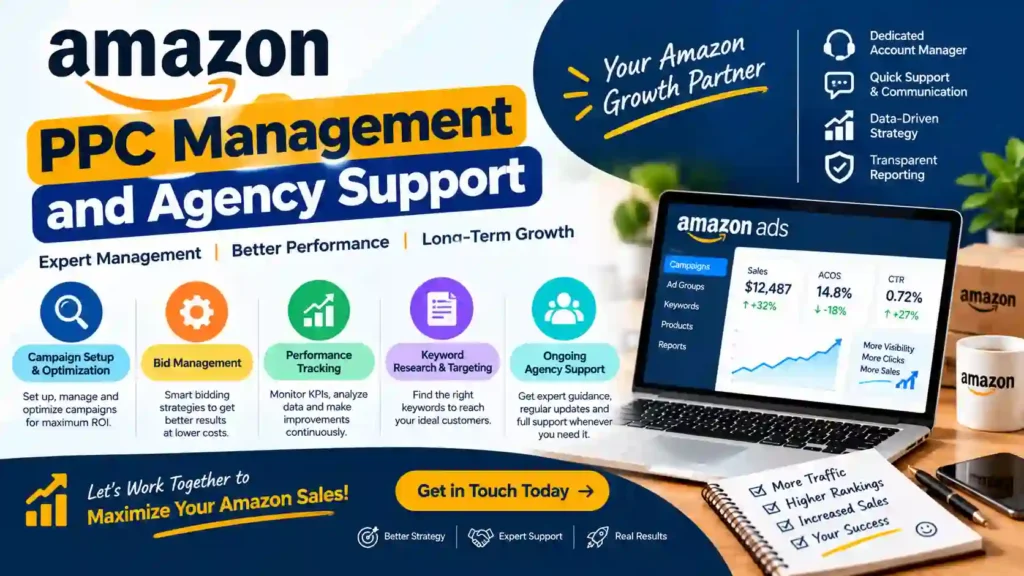
Some sellers prefer to manage advertising themselves, while others need professional support. The right choice depends on campaign complexity, available time, experience, and business goals.
When to Hire an Amazon PPC Virtual Assistant Service
An Amazon PPC virtual assistant service can support sellers with routine advertising tasks. Depending on their skills, a virtual assistant may help with:
- Keyword research and organization.
- Campaign creation and maintenance.
- Search-term report analysis.
- Negative keyword updates.
- Basic bid adjustments.
- Advertising performance reports.
A virtual assistant may be suitable for sellers who need operational support without hiring a full-time advertising team. However, confirm their experience, responsibilities, and reporting process before hiring.
How to Choose the Best Amazon PPC Management Agencies
Choosing an agency requires more than comparing service prices. Sellers should evaluate the provider’s experience, communication, strategy, and understanding of their product category.
Consider these factors before making a decision:
- Amazon advertising experience: Ask about previous campaign management experience and relevant product categories.
- Clear service details: Understand whether the agency handles keyword research, campaign setup, optimization, and reporting.
- Transparent pricing: Check management fees, advertising budgets, and any additional charges.
- Performance reporting: Look for regular reports covering important advertising metrics.
- Communication: Choose a provider that explains campaign decisions and responds to questions.
- Realistic expectations: Avoid agencies that guarantee specific sales, rankings, or profits without considering market conditions.
Compare multiple providers and ask for a clear explanation of how they plan to manage your campaigns.
Frequently Asked Questions About Amazon PPC Marketing Services
1. What Does Amazon PPC Do?
Amazon PPC helps sellers promote products through paid advertisements on Amazon. It can increase product visibility, attract relevant shoppers, and generate sales when campaigns target the right audience. Advertisers generally pay when shoppers click their ads.
2. How Much Does Amazon PPC Cost?
Amazon PPC costs vary depending on keyword competition, product category, bidding strategy, and advertising goals. Sellers can set campaign budgets and control their bids, but actual costs depend on clicks and campaign activity. There is no single fixed price for every seller.
3. Is PPC Better Than SEO?
PPC and SEO serve different purposes. Amazon PPC can provide paid visibility through advertising, while SEO focuses on improving organic visibility in search results. PPC may help generate traffic more quickly, whereas SEO can support long-term organic discovery. Many sellers use both approaches together.
4. How Much Does Amazon Charge for PPC?
Amazon generally charges advertisers when shoppers click their PPC ads. The cost per click depends on factors such as competition, bids, targeting, and advertising placement. Sellers should review their campaign settings and advertising reports to understand their actual spending.
5. What Is Amazon PPC Marketing?
Amazon PPC marketing is a paid advertising approach that allows sellers to promote products through Amazon’s advertising platform. It includes campaign planning, keyword or product targeting, bidding, budget management, and performance optimization.
Final Thoughts on Amazon PPC Marketing Services
Amazon advertising can help sellers improve product visibility and connect with shoppers who are interested in their products. However, successful campaigns require more than launching ads and increasing bids.
Effective Amazon PPC marketing services combine keyword research, campaign management, budget control, listing improvements, and regular performance analysis. Sellers should also monitor ACOS, TACOS, and other relevant metrics to understand how advertising contributes to business performance.