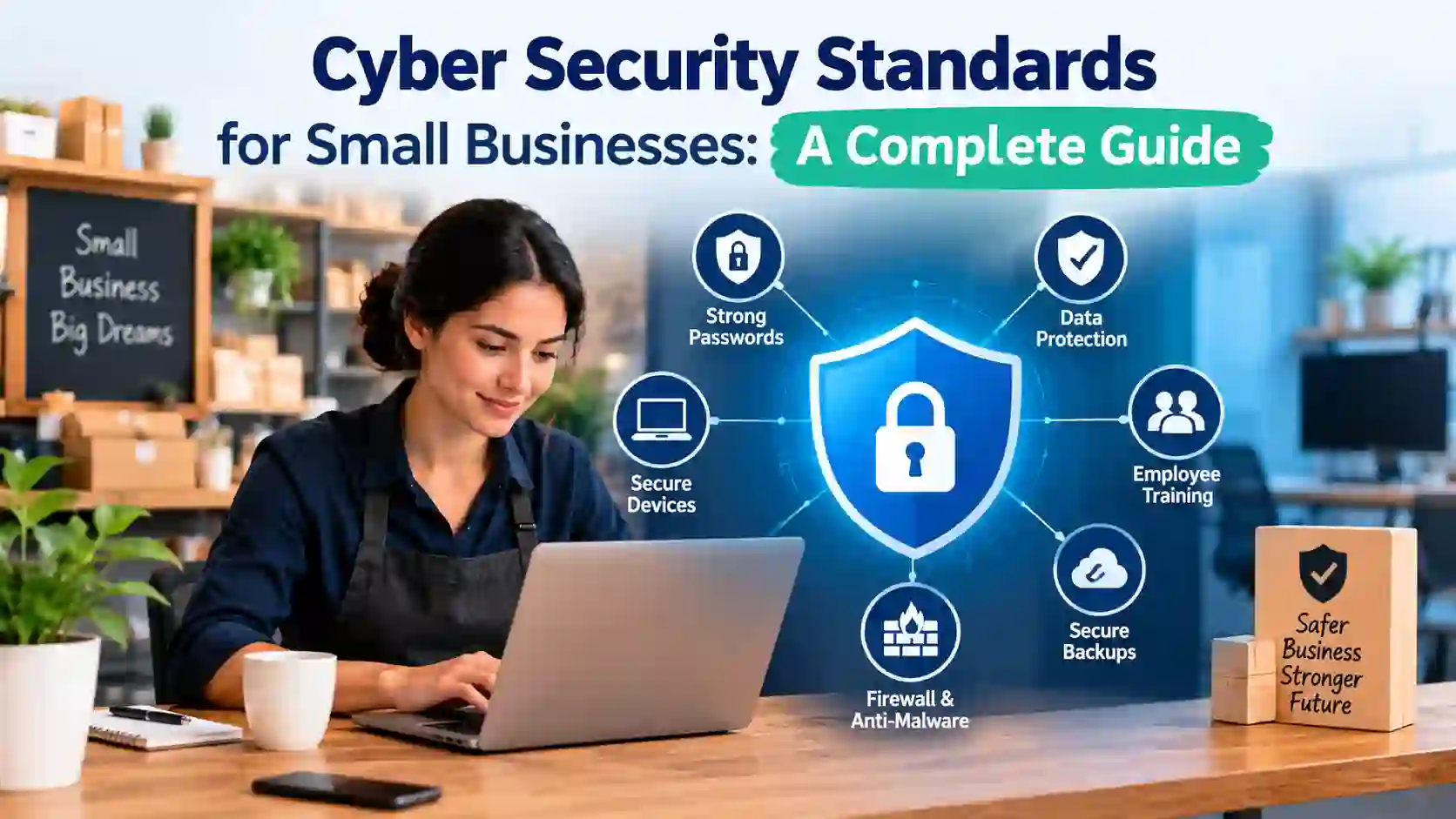
Cyber Security Standards for Small Businesses has become an important part of running a small business. A company may have only a few employees, but it can still handle customer information, payment details, business documents, employee records, and other sensitive data. This makes basic security practices important from the beginning.
Cyber security standards give businesses a structured way to protect their systems, data, devices, and users. Instead of relying on random security tools, a business can use recognized standards and best practices to identify risks, improve protection, and respond to security incidents.
What Are Cyber Security Standards?
Cyber security standards are organized guidelines that help businesses protect their information systems and reduce security risks. They provide a framework for managing areas such as access control, data protection, employee security, network protection, incident response, and risk management.
Different standards serve different purposes. Some focus on managing cybersecurity risks, while others help organizations demonstrate that they follow specific security controls or compliance requirements.
For a small business, following a standard does not always mean completing a complicated certification process. The business can first use the standard as a practical checklist to understand its current security position and identify areas that need improvement.
Standards vs. Regulations vs. Compliance
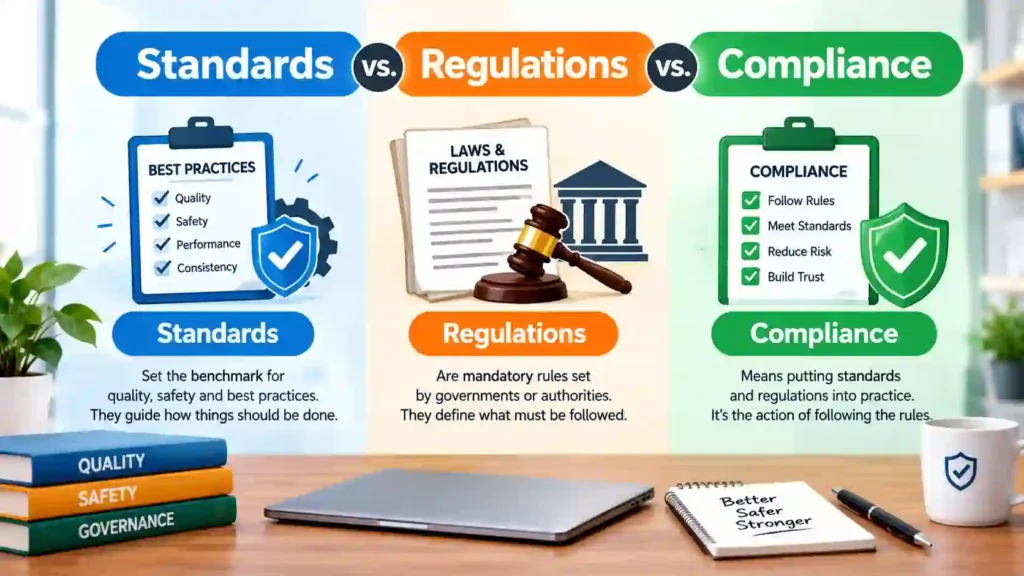
These three terms often appear together, but they have different meanings.
- Cybersecurity standards provide recommended frameworks, controls, or practices that organizations can use to improve security.
- Regulations are legal requirements that a business may need to follow depending on its location, industry, and the type of information it handles.
- Compliance means meeting the requirements that apply to the business. These requirements may come from laws, regulations, contracts, industry rules, or a particular security framework.
Understanding this difference helps small businesses choose security measures based on their actual needs instead of trying to follow every available framework.
Why Cyber Security Standards Matter for Small Businesses
Small businesses often work with limited budgets and smaller IT teams. That can make it difficult to manage every cybersecurity risk at once. A clear standard can help the business organize its priorities and focus on the controls that matter most.
Cyber security standards for businesses can also create consistency. Employees know how to handle company information, managers can track security responsibilities, and IT teams can follow defined procedures instead of making decisions from scratch each time.
Common Cyber Threats Facing Small Businesses
Small businesses can face many of the same cyber threats as larger organizations. Common examples include phishing, ransomware, stolen passwords, malware, business email compromise, and unauthorized access.
Phishing attacks often target employees through emails or messages that appear legitimate. Attackers may try to steal login details or convince an employee to open a harmful attachment.
Ransomware can prevent access to important files and systems. Attackers may demand payment in exchange for restoring access, although paying does not guarantee recovery.
Weak or reused passwords can also create security problems. If attackers obtain one password, they may try it across multiple business accounts.
These risks show why a business needs more than one security measure. Strong passwords, multi-factor authentication, employee training, backups, software updates, and access controls can work together to create stronger protection.
Common Security Gaps in Small Businesses
A small business may have security gaps without realizing it. For example, employees might share passwords, old user accounts might remain active, software might not receive regular updates, or important files might have no reliable backup.
Another common issue involves access permissions. Employees should not automatically receive access to every company system or file. Businesses can follow the least-privilege principle by giving users only the access they need for their work.
Remote work can create additional challenges. Employees may use personal networks or devices, which makes device security, authentication, and secure access more important.
A simple security review can help a business identify these weaknesses before they become larger problems.
The Business Impact of a Data Breach
A cyberattack can affect more than a company’s computer systems. A breach may interrupt daily operations, expose sensitive information, create recovery costs, and damage customer trust.
The impact can vary depending on the type of attack, the information involved, and how quickly the business responds. Small businesses may also face additional pressure because they often have fewer resources available for recovery.
This makes prevention and preparation important. A business should know what information needs protection, who can access it, how it backs up critical data, and what steps employees should take after a security incident.
Using recognized cyber security standards and best practices can give small businesses a structured starting point. Instead of treating cybersecurity as a collection of separate tools, the business can build a clear process for identifying risks, protecting important assets, and improving security over time.
Cyber Security Standards and Best Practices for Businesses
Cybersecurity standards provide a framework, but small businesses also need practical security measures that employees can follow every day. A good approach combines technology, policies, employee awareness, and regular checks.
The goal is not to use every available security product. Instead, businesses should focus on protecting important systems and data with security controls that match their risks.
Use Strong Passwords and Multi-Factor Authentication
Strong, unique passwords can reduce the risk of unauthorized access. Employees should avoid using the same password for multiple business accounts.
Multi-factor authentication (MFA) adds another layer of protection. Even if someone obtains a password, MFA can require an additional verification step before allowing access.
Businesses should enable MFA for important accounts such as email, cloud services, financial platforms, and administrator accounts whenever the service supports it.
Secure Business Devices and Endpoints
Laptops, desktops, smartphones, and other connected devices can provide attackers with a path into business systems. Small businesses should keep these devices protected with appropriate security software and configuration controls.
Employees should use screen locks, updated operating systems, secure applications, and approved devices when accessing company information. Businesses can also maintain an inventory of company devices so they know which systems require protection.
Keep Software and Systems Updated
Software updates often include security fixes. Delaying updates can leave known vulnerabilities available to attackers.
Businesses should establish a regular update process for operating systems, applications, browsers, plugins, and other software. Automatic updates can help where they make sense, while critical business systems may need controlled testing before an update.
Back Up and Protect Important Data
A reliable backup can help a business recover important information after accidental deletion, hardware failure, ransomware, or another security incident.
Businesses should identify critical files and systems and create regular backups. Keeping a separate backup copy can provide additional protection if an attacker compromises the main environment.
Sensitive information also needs appropriate protection during storage and transfer. Encryption can help reduce the risk of exposing data if unauthorized people gain access to a device or storage system.
Control User Access
Not every employee needs access to every file or system. Access controls help businesses limit who can view, change, or manage sensitive information.
The least-privilege principle means users receive only the permissions they need to perform their responsibilities. Businesses should also review user accounts regularly and remove access when an employee leaves or changes roles.
Train Employees to Recognize Security Risks
Employees play an important role in a company’s security. Regular training can help them recognize suspicious emails, unsafe links, unusual login requests, and other common warning signs.
A simple reporting process also matters. Employees should know who to contact when they suspect a phishing attempt, lost device, unauthorized login, or other security issue.
Training should not happen only once. Short, regular reminders can help employees keep security practices in mind during their normal work.
Key Cyber Security Standards for Small Businesses
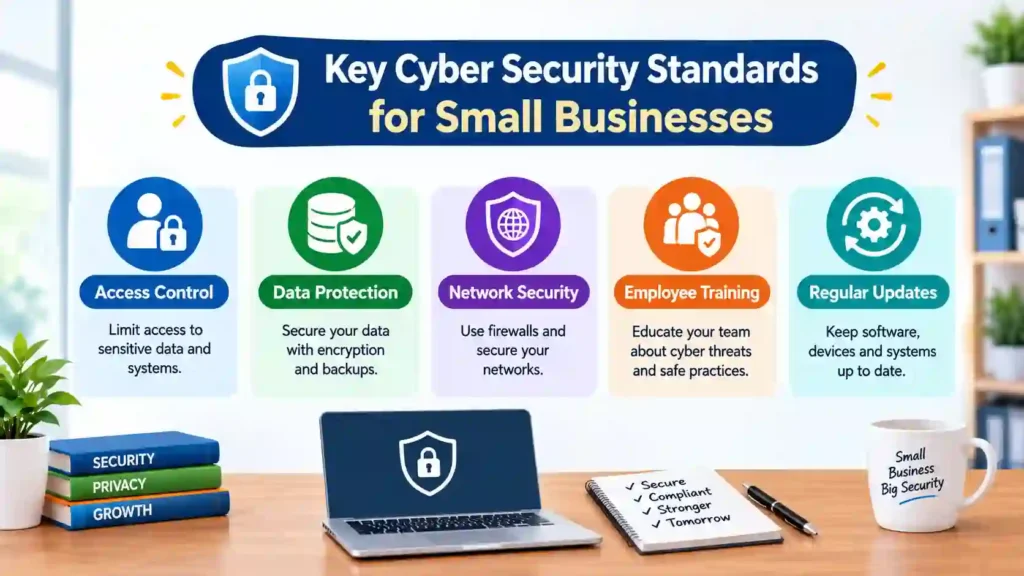
Small businesses can choose from several recognized cybersecurity frameworks and standards. The right option depends on the company’s industry, size, customers, data, and compliance obligations.
NIST Cybersecurity Framework
The NIST Cybersecurity Framework helps organizations manage cybersecurity risk through a structured approach. Its core functions include identifying risks, protecting assets, detecting security events, responding to incidents, and recovering from them.
Small businesses can use the framework as a practical starting point without treating it as a requirement to purchase specific products.
ISO 27001
ISO/IEC 27001 focuses on information security management. It helps organizations establish a systematic approach to managing information security risks through an Information Security Management System (ISMS).
A small business may use ISO 27001 principles to organize security policies, risk management, access controls, incident management, and continual improvement. Organizations that need formal certification can follow the relevant certification process.
CIS Controls
The CIS Controls provide a prioritized set of security safeguards. They cover areas such as asset management, account management, vulnerability management, data protection, and incident response.
For smaller companies with limited resources, prioritized controls can help the team focus on practical improvements instead of trying to address every security issue simultaneously.
SOC 2 and Other Frameworks
SOC 2 focuses on controls related to areas such as security, availability, processing integrity, confidentiality, and privacy. It often matters to technology companies and service providers that need to demonstrate how they protect customer information.
Businesses may also need industry-specific frameworks or requirements. The appropriate choice depends on what the company does, where it operates, what information it handles, and what customers or partners require.
No single framework fits every small business. A company should first understand its risks and obligations, then select the standards that support its business needs.
Cyber Security Standards Compliance Requirements for Small Businesses
Cyber security standards compliance requirements can vary from one business to another. A small company does not necessarily need to follow every cybersecurity framework. Its requirements usually depend on its industry, location, customers, business partners, and the type of information it handles.
Before choosing a standard, a business should identify the rules and contractual requirements that apply to its operations. This approach helps the company focus its time and resources on relevant security controls.
Cyber Security Standards Compliance Requirements for Businesses
Businesses should start by identifying the information and systems that need protection. This may include customer records, payment information, employee data, intellectual property, financial documents, and cloud accounts.
Next, the business can compare its current security practices with the requirements of the relevant standard or regulation. This process can reveal gaps such as weak access controls, missing backups, outdated software, or incomplete security policies.
Documentation also plays an important role. A business should keep clear records of security policies, access reviews, employee training, risk assessments, incident response procedures, and other relevant controls.
Cyber Security Standards and Regular Security Reviews
Cybersecurity should not become a one-time project. Businesses should review their security controls regularly because systems, employees, software, and cyber threats can change over time.
Regular reviews can help identify new risks and confirm whether existing controls still work as intended. Businesses can also use security assessments, vulnerability scans, access reviews, and internal checks to monitor their progress.
How to Choose Cyber Security Standards for Small Businesses
Choosing the right standard starts with understanding the business. A small company should consider its industry, customers, data, technology, and legal obligations before selecting a framework.
A practical framework can help a business organize security work without creating unnecessary complexity.
Choosing Cyber Security Standards Based on Business Size and Industry
Different industries face different security expectations. A software company, healthcare provider, financial business, and automotive supplier may have very different cybersecurity requirements.
Industry requirements can also influence customer contracts and business partnerships. A small company should therefore check whether customers, suppliers, regulators, or industry bodies expect a particular security standard.
Choosing Cyber Security Standards Based on Data and Risk
The type of information a business stores can influence its security priorities. Companies that handle financial, personal, health, or confidential business information may need stronger controls.
A basic risk assessment can help identify valuable assets, possible threats, vulnerabilities, and potential business impact. The business can then prioritize controls that address its most important risks.
Choosing Cyber Security Standards Based on Budget and Resources
Small businesses often have limited cybersecurity budgets and small IT teams. They can start with practical controls that address major risks instead of attempting to implement everything at once.
For example, a business can begin with MFA, secure backups, software updates, access controls, employee training, and endpoint protection. It can then expand its security program as its needs and resources grow.
Cybersecurity Compliance Software for Small Businesses
Cybersecurity compliance software can help businesses organize security tasks, track controls, manage documentation, and monitor compliance activities.
Instead of keeping everything in separate spreadsheets or documents, a suitable platform can bring important compliance information into one place. Depending on the software, features may include risk tracking, policy management, assessment workflows, evidence collection, control monitoring, and reporting.
Cybersecurity Compliance Software and Security Standards
Compliance software does not replace cybersecurity standards or security expertise. It supports the processes that help a business manage those requirements.
For example, a company following a security framework can use software to track which controls it has implemented, which areas need attention, and what evidence supports its compliance activities.
Before selecting cybersecurity compliance software, a business should check whether the platform supports the frameworks and requirements that actually apply to its operations.
Automotive Cyber Security Standards for Businesses
Automotive businesses face security challenges that go beyond traditional office systems. Modern vehicles can connect to networks, cloud services, mobile applications, sensors, and other digital systems.
Because of these connections, automotive companies may need to consider automotive cyber security standards and industry-specific cybersecurity requirements.
Automotive Cyber Security Standards and Connected Vehicles
Connected vehicles can exchange data with external systems and services. Security teams therefore need to consider risks across vehicle systems, software, communications, and supporting infrastructure.
Automotive suppliers may also need to meet cybersecurity expectations from manufacturers and business partners. The exact requirements depend on the company’s role within the automotive supply chain.
Automotive Cyber Security Standards and Supply Chain Security
Automotive cybersecurity also involves third-party risk. A vulnerability at a supplier or technology partner can create security concerns for other organizations in the supply chain.
Businesses can reduce this risk by reviewing supplier security practices, defining security requirements in contracts, controlling access to shared systems, and monitoring important third-party relationships.
The key lesson for small automotive businesses is simple: cybersecurity should cover both internal systems and the wider digital supply chain.
Frequently Asked Questions About Cyber Security Standards
What Are Cyber Security Standards?
Cyber security standards are structured guidelines that help organizations protect their systems, networks, devices, and information. They provide a consistent way to identify risks, apply security controls, manage incidents, and improve cybersecurity over time.
Small businesses can use standards such as NIST, ISO 27001, and CIS Controls to create a more organized security program. The right choice depends on the company’s industry, risks, customers, and compliance obligations.
What Are the ISO Standards for Cyber Security?
ISO/IEC 27001 is the main ISO standard associated with information security management. It provides requirements for creating and maintaining an Information Security Management System (ISMS).
Businesses can use ISO 27001 to manage information security risks through policies, risk assessments, access controls, security procedures, and continual improvement. Organizations that need formal certification can follow the appropriate certification process.
What Are the 7 Types of Cyber Security?
The commonly discussed types of cybersecurity include network security, information security, application security, endpoint security, cloud security, identity and access management, and operational security.
These areas work together rather than functioning as completely separate solutions. For example, access management can protect accounts, endpoint security can protect business devices, and network security can help protect communications and connected systems.
What Are the 7 Pillars of Cybersecurity?
The seven pillars commonly used to describe a broad cybersecurity program include security governance, risk management, identity and access management, data security, infrastructure security, security operations, and security awareness.
The exact terminology can differ between cybersecurity frameworks and organizations. The underlying idea remains similar: effective security requires a combination of technology, processes, governance, and people.
Conclusion: Cyber Security Standards for Small Businesses
Cyber security standards for small businesses provide a practical way to organize security efforts and manage cyber risks. They can help businesses understand their security gaps, protect important information, control access, train employees, and prepare for security incidents.
Small businesses do not need to implement every available framework. Instead, they should identify their most important systems and data, understand their legal and contractual obligations, and choose standards that match their actual needs.