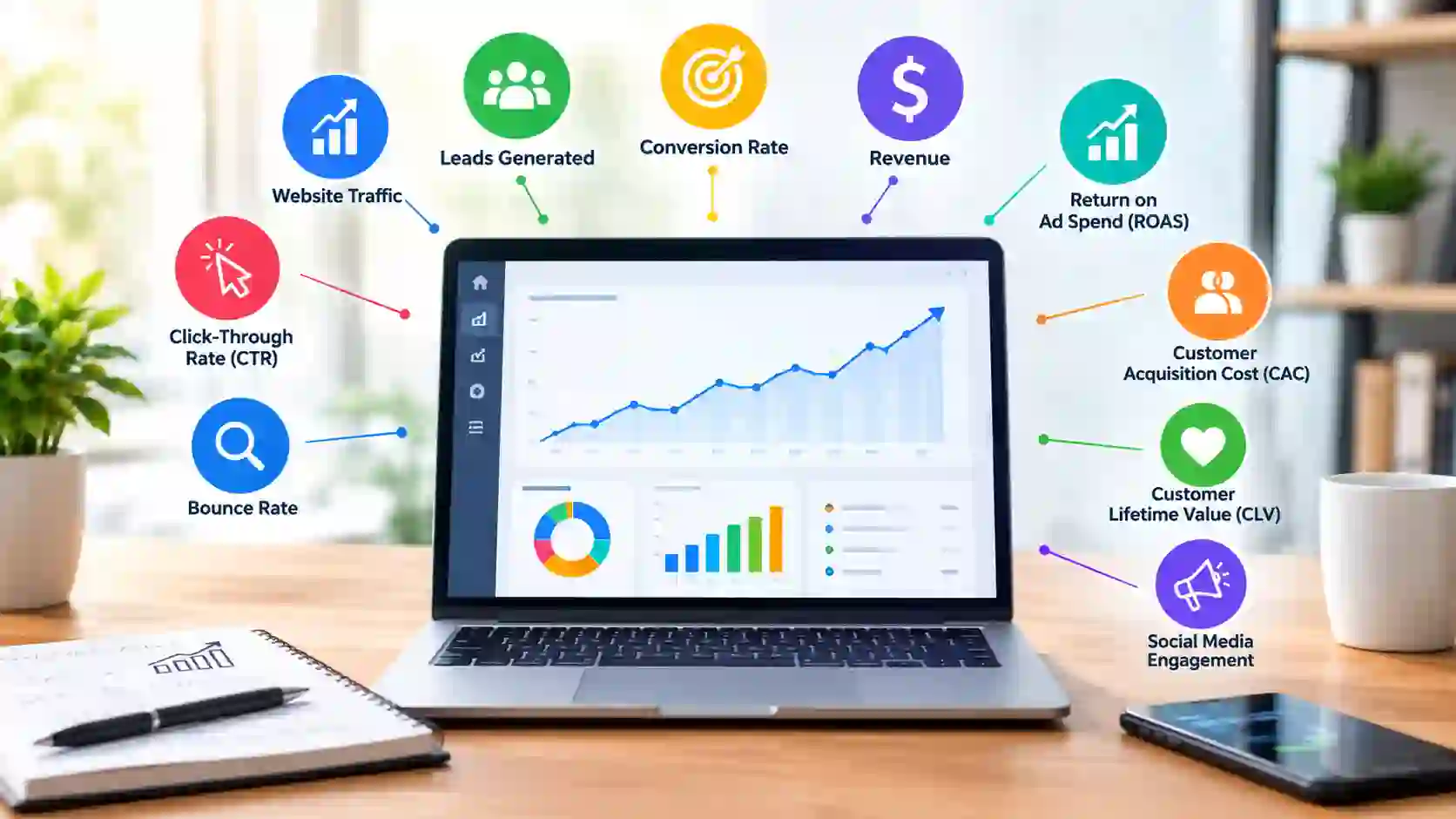
Digital Marketing KPIs for Small Business invest time and money in SEO, social media, paid advertising, email campaigns, and content marketing. But simply running these activities does not show whether they are producing useful results. Businesses need clear measurements to understand what is working and where they should improve.
Digital Marketing KPIs for Small Business help owners and marketers connect their online activities with specific goals. These measurements can show whether a campaign is attracting visitors, generating leads, increasing sales, or improving customer engagement.
What Are Digital Marketing KPIs for Small Business?
Digital marketing KPIs are measurable values that help a business evaluate the performance of its online marketing activities. The term KPI stands for Key Performance Indicator.
For a small business, a KPI should relate to an important marketing or business objective. For example, if a company wants to generate more leads through its website, it may monitor conversion rate, leads generated, and cost per acquisition.
If the goal is to increase visibility in search engines, organic traffic and keyword performance may provide useful information.
This means there is no single KPI that works for every business. The right measurements depend on the company’s goals, audience, marketing channels, and budget.
Why Are Digital Marketing KPIs Important for Small Businesses?

Small businesses often need to use their Digital Marketing KPIs for Small Business budgets carefully. Tracking the right indicators can help them understand whether their efforts are contributing to their objectives.
Measure Marketing Performance
KPIs provide measurable information about marketing activities. Instead of relying only on opinions or assumptions, businesses can review data to understand how their campaigns perform.
For example, a business running a social media campaign can examine engagement, clicks, and conversions to understand how people respond to its content.
Track Progress Toward Business Goals
Marketing activities should support a clear business objective. KPIs make it easier to monitor progress toward that objective.
A small business focused on online sales may pay attention to conversions and revenue, while a business focused on generating enquiries may monitor leads and acquisition costs.
Find Opportunities to Improve
Performance data can reveal areas that need attention. If a website receives a large amount of traffic but generates very few enquiries, the business can investigate its landing pages, offers, or calls to action.
This creates an opportunity to improve the customer journey instead of simply increasing traffic.
Make Better Marketing Decisions
KPIs can help businesses compare campaign results and decide where to focus their resources.
For example, if one marketing channel consistently generates qualified leads at a lower cost, the business can examine its performance alongside other channels before deciding how to allocate its budget.
KPI vs. Metric: What Is the Difference?
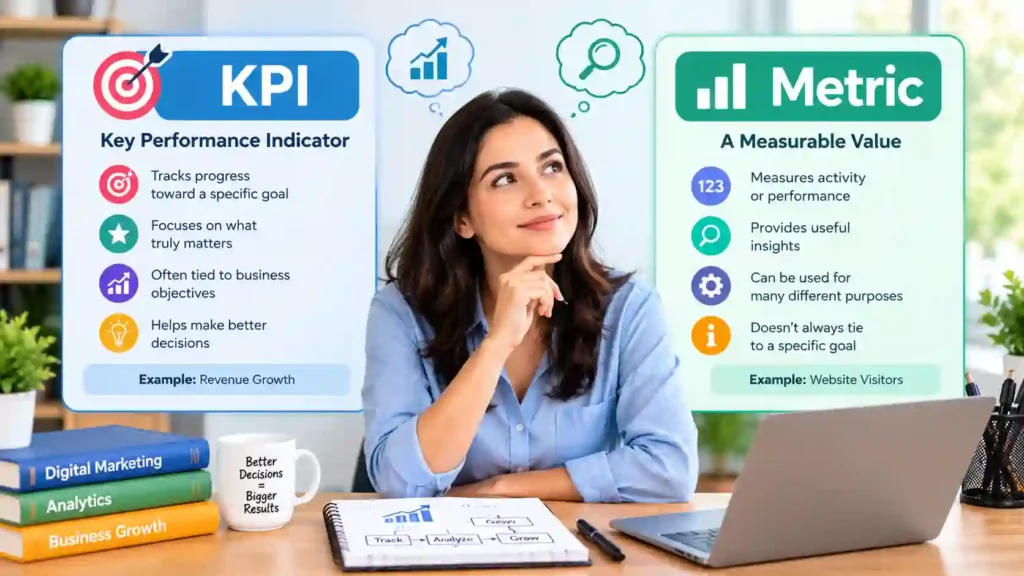
A metric is a measurable value that provides information about performance. A KPI is a measurement that a business chooses to monitor because it directly relates to an important goal.
For example, website visitors are a useful metric. However, if the main goal is to generate sales, conversion rate or revenue may be more closely connected to that objective.
Therefore, every KPI is a metric, but not every metric is a KPI.
The most useful measurements are those that help a business understand whether it is moving toward a specific goal. Small businesses do not need to track every available number. They should focus on the data that can support meaningful marketing decisions.
10 Digital Marketing KPIs for Small Business That Matter
The most useful KPIs depend on what a business wants to achieve. A small business focused on sales may need different measurements from one focused on brand awareness or lead generation.
The following 10 metrics can help small businesses evaluate different parts of their online marketing performance.
1. Website Traffic
Website traffic shows how many people visit a website during a specific period. It can help a business understand whether its marketing activities are bringing people to its online presence.
Businesses can review traffic from different sources, such as:
- Organic search
- Social media
- Paid advertising
- Referral websites
- Direct visits
However, high traffic does not always mean strong marketing performance. A website may receive many visitors without generating leads or sales. That is why traffic should usually be considered alongside engagement and conversion data.
2. Conversion Rate
Conversion rate measures the percentage of visitors who complete a desired action. The action could be purchasing a product, submitting a contact form, signing up for a newsletter, or requesting a quote.
The basic formula is:
Conversion Rate = (Number of Conversions ÷ Number of Visitors) × 100
For example, if 1,000 people visit a website and 50 complete a desired action, the conversion rate is 5%.
This KPI can help small businesses understand whether their website and marketing campaigns are encouraging visitors to take meaningful actions.
3. Click-Through Rate (CTR)
Click-through rate measures how often people click a link, advertisement, email button, or search result after seeing it.
The formula is:
CTR = (Number of Clicks ÷ Number of Impressions) × 100
For example, if an online advertisement receives 100 clicks from 5,000 impressions, its CTR is 2%.
A higher CTR can indicate that the message, offer, or headline attracts attention. However, CTR should not be evaluated alone. Businesses should also check whether those clicks lead to useful actions such as enquiries, sign-ups, or purchases.
4. Cost Per Click (CPC)
Cost per click shows how much an advertiser pays, on average, for each click on a paid advertisement.
The formula is:
CPC = Total Advertising Cost ÷ Number of Clicks
For example, if a campaign spends $100 and receives 200 clicks, the average CPC is $0.50.
CPC can help small businesses monitor advertising costs and compare campaigns. A lower CPC may reduce the cost of generating website visits, but businesses should also consider the quality of those clicks and whether they lead to conversions.
5. Cost Per Acquisition (CPA)
Cost per acquisition measures the average amount spent to generate a specific customer or conversion.
The formula is:
CPA = Total Marketing Cost ÷ Number of Acquisitions
For example, if a campaign costs $500 and generates 25 customers, the CPA is $20.
This measurement can be especially useful for small businesses because it connects marketing spending with actual customer acquisition. Comparing CPA across campaigns can help businesses understand which activities generate customers within their target cost.
CPA should also be considered alongside revenue and customer value. A campaign with a higher acquisition cost may still produce valuable customers, while a low-cost campaign may not generate enough revenue to support the business.
6. Return on Investment (ROI)
Return on investment (ROI) measures the financial return generated from an investment compared with its cost. In Digital marketing KPIs, it can help a business understand whether its marketing spending is contributing to profitable results.
A basic formula is:
ROI = (Return − Investment Cost) ÷ Investment Cost × 100
For example, if a business spends $1,000 on marketing and generates $1,500 in profit from that investment, the ROI is 50%.
ROI provides a broader view of marketing performance because it considers financial returns rather than focusing only on clicks or website visits. Small businesses can use it to compare marketing activities with their overall financial goals.
7. Return on Ad Spend (ROAS)
Return on ad spend (ROAS) measures the revenue generated for each amount spent on advertising.
The formula is:
ROAS = Revenue from Ads ÷ Advertising Cost
For example, if a business spends $500 on an advertising campaign and generates $2,000 in attributed revenue, its ROAS is 4. This means the campaign generated $4 in revenue for every $1 spent on advertising.
ROAS is particularly useful for paid advertising campaigns. However, it does not include every business expense, such as product costs, salaries, or other operating expenses. Businesses should therefore consider it alongside profitability and other financial measures.
8. Engagement Rate
Engagement rate measures how actively people interact with digital content. It is commonly used for social media posts, videos, and other forms of online content.
Depending on the platform, engagement can include:
- Likes
- Comments
- Shares
- Saves
- Clicks
- Other interactions
For example, a small business may compare the engagement generated by different social media posts to identify the types of content that receive more interaction.
Engagement does not automatically lead to sales, but it can provide useful information about how audiences respond to a brand’s content. Businesses should connect engagement data with other objectives when evaluating overall performance.
9. Customer Acquisition Cost (CAC)
Customer acquisition cost (CAC) measures the average amount a business spends to acquire a new customer.
A basic formula is:
CAC = Total Sales and Marketing Costs ÷ Number of New Customers
For example, if a business spends $2,000 on sales and marketing and gains 100 new customers, its CAC is $20 per customer.
Tracking this measurement can help small businesses understand how much they are spending to grow their customer base. It becomes more useful when compared with customer lifetime value.
If acquiring customers costs significantly more than the value those customers generate, the business may need to review its pricing, marketing channels, retention strategy, or customer experience.
10. Customer Lifetime Value (CLV)
Customer lifetime value (CLV) estimates the total value a customer may generate for a business during the relationship with that customer.
A simple approach can consider:
CLV = Average Purchase Value × Purchase Frequency × Customer Lifespan
For example, if a customer typically spends $50 per purchase, buys four times a year, and remains a customer for three years, the estimated value is $600. CLV gives small businesses a longer-term view of customer value. It can help them understand how much they can reasonably invest in acquiring and retaining customers.
Looking at CAC and CLV together can provide more useful information than examining either measurement alone. CAC focuses on the cost of gaining customers, while CLV focuses on the value those customers may provide over time.
Common Digital Marketing KPIs for Small Businesses
Businesses can track many types of performance data across their online marketing channels. The most useful measurements depend on the campaign objective and the stage of the customer journey.
Some common digital marketing KPIs include:
- Website traffic
- Conversion rate
- Click-through rate (CTR)
- Cost per click (CPC)
- Cost per acquisition (CPA)
- Return on investment (ROI)
- Return on ad spend (ROAS)
- Engagement rate
- Customer acquisition cost (CAC)
- Customer lifetime value (CLV)
These measurements cover different areas of marketing performance. For example, traffic can show how many people reach a website, while conversion rate can show how many visitors complete a desired action.
Small businesses should avoid tracking every available number without a clear purpose. Instead, they can select measurements that directly support their marketing goals.
Digital Marketing Metrics and Digital Marketing KPIs
The terms metrics and KPIs are often used interchangeably, Digital marketing KPIs but they have different roles.
A metric is any measurable piece of data that provides information about performance. A Digital marketing KPIs is a metric that a business selects as an important indicator of progress toward a specific goal.
For example, a business may track:
Metric: Website page views
KPI: Website conversion rate
Page views can provide useful information about website activity. However, if the business wants to increase online enquiries, conversion rate may be more closely connected to that objective.
Another example is social media marketing. A business can measure likes, comments, shares, reach, and clicks. These are all useful metrics, but the business may select engagement rate as a KPI if improving audience interaction is one of its main goals.
Why the Difference Matters for Small Businesses
Small businesses often have limited time and resources. Tracking too many measurements can make reports difficult to understand and may distract from the numbers that actually matter.
A focused KPI system makes it easier to answer questions such as:
- Are we reaching the right audience?
- Are visitors taking valuable actions?
- How much does it cost to acquire a customer?
- Are marketing campaigns generating enough revenue?
- Which channels are contributing to business goals?
The goal is not to collect as much data as possible. The goal is to identify the measurements that provide useful information for making marketing decisions.
How to Choose the Right Digital Marketing KPIs
The right KPIs start with a clear goal. A business should first decide what it wants to achieve and then select measurements that can show progress.
For example:
- Website leads: Relevant KPIs may include conversion rate, number of qualified leads, and cost per acquisition.
- Online sales: Relevant measurements may include conversion rate, revenue, ROI, and ROAS.
- Improve social media engagement: Relevant KPIs may include engagement rate, shares, comments, and clicks.
- Reduce customer acquisition costs: CAC and CPA can provide useful information about acquisition expenses.
This approach prevents businesses from choosing KPIs simply because they are popular or easy to measure. A KPI should have a clear connection to the result the business wants to improve.
SEO KPIs for Small Business Marketing
Search engine optimization can help small businesses attract people who are actively searching for relevant products, services, or information. Tracking the right SEO measurements can show whether search visibility is improving.
Useful SEO KPIs include:
- Organic traffic
- Keyword rankings
- Organic click-through rate
- Conversion rate from organic traffic
- Backlink growth
Organic traffic shows how many visitors arrive through unpaid search results. Keyword rankings can help businesses monitor how their important search terms perform over time.
However, rankings alone do not show the complete picture. A business should also consider whether organic visitors engage with the website and complete valuable actions.
PPC KPIs: Important Metrics for Small Businesses
Pay-per-click advertising can provide quick visibility, but advertising costs can add up quickly. Small businesses can use PPC KPIs to monitor both campaign performance and spending.
Important measurements include:
- Click-through rate (CTR)
- Cost per click (CPC)
- Conversion rate
- Cost per acquisition (CPA)
- Return on ad spend (ROAS)
These measurements can help advertisers understand how users respond to their ads and how much they spend to generate results.
For example, CTR can provide information about how well an advertisement attracts clicks, while CPA focuses on the cost of generating a conversion. ROAS goes a step further by comparing advertising costs with attributed revenue.
Social Media Marketing KPIs for Small Businesses
Social media performance cannot be measured by follower count alone. A small business should choose measurements based on what it wants to achieve through social platforms.
Common social media KPIs include:
- Engagement rate
- Reach
- Impressions
- Clicks
- Follower growth
- Social media conversions
Engagement rate can help businesses understand how audiences interact with their content. Reach shows how many unique users may have seen the content, while impressions represent the number of times content was displayed.
If the main goal is to generate website visits or sales, clicks and conversions may provide more useful information than follower growth alone.
Content Marketing KPIs: Metrics to Track
Content marketing can include blog posts, guides, videos, infographics, and other resources. Businesses can use performance data to understand whether their content attracts and engages the intended audience.
Useful measurements include:
- Organic traffic to content
- Time spent on important pages
- Engagement
- Social shares
- Leads generated
- Content-driven conversions
For example, a blog post may attract thousands of visitors but generate very few leads. Another article may receive less traffic but produce more enquiries. Looking at both traffic and conversions can help businesses understand the actual value of their content.
Email Marketing KPIs for Small Business Campaigns
Email marketing gives businesses a direct way to communicate with subscribers and customers. Several measurements can help evaluate the performance of email campaigns.
Common email KPIs include:
- Open rate
- Click-through rate
- Conversion rate
- Unsubscribe rate
- Bounce rate
- Revenue generated from email campaigns
Open rate can provide information about how subscribers respond to an email subject line, while click-through rate shows whether recipients interact with the links or calls to action.
Conversion rate and revenue can provide a deeper view when the purpose of an email campaign is to generate sales or other valuable actions.
The most useful measurement depends on the campaign objective. An email designed to drive sales should not be evaluated in exactly the same way as an email intended to provide information or build engagement.
How to Track KPIs for Small Business Marketing
Tracking KPIs does not mean checking every number every day. Small businesses can create a simple measurement process based on their goals and the marketing channels they use.
1. Set a Clear Marketing Goal
Start by deciding what you want to achieve. Your goal could be to increase website leads, generate more sales, reduce advertising costs, or improve customer engagement.
A clear goal makes it easier to choose relevant KPIs.
2. Choose Relevant KPIs
Select a small number of measurements that directly relate to your goal. For example, a business focused on lead generation may track conversion rate, qualified leads, and CPA.
Avoid selecting KPIs simply because they are easy to measure. Each one should provide useful information about your progress.
3. Use Analytics and Marketing Tools
Different tools can help businesses collect performance data. Website analytics platforms can provide information about traffic and conversions, while advertising platforms can show data such as clicks, CPC, and ROAS.
SEO and social media platforms can also provide channel-specific performance information.
4. Compare Results Over Time
A single report does not always provide enough context. Compare performance across different periods to identify changes and trends.
For example, a business can compare this month’s conversion rate with the previous month’s result. It can also compare different campaigns to see which ones generated more valuable outcomes.
5. Review and Adjust
KPI tracking should lead to action. If a campaign is not meeting its objective, review the data to identify possible reasons. A business might adjust its targeting, landing page, content, advertising message, or budget based on what the data shows.
The purpose of tracking is not simply to create reports. It is to use performance information to make better marketing decisions.
FAQs About Digital Marketing KPIs
What are the most important KPIs for marketing?
The most important KPIs depend on the marketing goal. Common examples include conversion rate, ROI, CPA, ROAS, customer acquisition cost, website traffic, and engagement rate. A business should select measurements that directly relate to its objectives rather than tracking every available metric.
What are the KPIs for digital marketing?
Common digital marketing KPIs include website traffic, conversion rate, CTR, CPC, CPA, ROI, ROAS, engagement rate, CAC, and CLV. The most relevant choices depend on the channel and the result a business wants to achieve.
What is a good KPI for digital marketing?
A good Digital marketing KPIs is measurable, relevant to a specific goal, and useful for making decisions. For example, conversion rate can be a useful KPI when a business wants to increase leads or sales, while engagement rate may be more relevant when the goal is to improve audience interaction.
Conclusion
Tracking the right performance indicators can help small businesses understand how their Digital marketing KPIs efforts contribute to their goals. The key is to focus on measurements that support real business decisions. Instead of trying to track every available number, choose a manageable set of KPIs, review them regularly, and use the results to improve your marketing strategy.
Digital Marketing KPIs for Small Business can become more than numbers in a report. They can help businesses understand performance, manage resources, and make informed decisions about their online marketing activities.