Market Intelligence Tools 2027 Understanding your market is essential for making smarter business decisions. Companies need to know what their competitors offer, what customers want, and which industry trends could affect their growth. However, collecting this information manually can take hours and still leave important gaps.
That is where the best market intelligence tools can help. These platforms collect and organize valuable market data, track competitor activities, identify customer interests, and reveal opportunities that businesses might otherwise miss.
Whether you run a small business, manage a marketing team, or work as a market researcher, the right tool can help you understand your industry and make decisions with greater confidence.
What Are Market Intelligence Tools in 2027?
Market intelligence is the process of collecting, analyzing, and interpreting information about your industry, competitors, customers, and market conditions. Businesses use these insights to understand their position in the market, recognize emerging opportunities, and reduce uncertainty when planning their next steps.
For instance, a company might notice that several competitors have started offering subscription plans. By researching customer demand and competitor pricing, the company can determine whether introducing its own subscription service makes business sense.
Market Intelligence Tools 2027 can include several types of information:
- Competitor intelligence: Information about competitors’ products, pricing, marketing strategies, strengths, and weaknesses.
- Customer intelligence: Insights into customer preferences, buying behavior, needs, and feedback.
- Industry intelligence: Information about market trends, new technologies, industry developments, and changing demand.
- Market opportunity analysis: Research that helps businesses identify underserved audiences, potential niches, and areas for growth.
The right research approach depends on your goals. A digital marketer might focus on website traffic, search visibility, and advertising strategies, while a business owner might prioritize customer demand, market size, and competitor pricing.
Market intelligence tools simplify this research by bringing relevant information into one place or making it easier to analyze data from multiple sources.
Why Are the Best Market Intelligence Tools Important for Businesses?
Businesses face constant changes in customer expectations, competitor strategies, and industry trends. Without reliable market information, they may invest in the wrong marketing channels, overlook customer needs, or miss opportunities to improve their products.
1. Understand Your Competitors
Competitor research helps you discover what other businesses do well and where they fall short. You can examine their website traffic, content strategies, product offerings, pricing, and digital marketing activities.
For example, a company might discover that a competitor receives significant organic traffic from informational blog posts. This insight could encourage the company to create more useful content around related customer questions.
However, competitor data does not automatically reveal why a strategy works. You should combine these findings with your own audience research and performance data before making major changes.
2. Discover New Market Opportunities
Market research can reveal growing customer interests, underserved audiences, and topics that competitors have not covered effectively.
Suppose you operate a software company and notice that small businesses frequently search for affordable automation solutions. You could investigate this demand, review existing products, and determine whether your company can offer a useful alternative.
Market intelligence tools help you investigate these opportunities before committing significant resources.
3. Improve Marketing Decisions
Marketing teams need to understand which audiences to target, which messages to use, and which channels deserve their attention.
Market Intelligence Tools 2027 can help you identify competitor keywords, popular content topics, audience interests, and changes in search demand. You can then use these insights to improve your SEO, content marketing, advertising, and social media campaigns.
For example, if research reveals that your competitors receive traffic from comparison articles, you could create an honest comparison guide that explains the differences between products and helps customers make informed decisions.
4. Monitor Industry Trends
Customer preferences and market conditions can change quickly. Businesses that monitor these changes can respond more effectively than those that rely only on outdated research.
Depending on the platform, you may track search trends, company announcements, news coverage, consumer discussions, or changes in competitor activity.
These insights can help you recognize emerging interests and review your business strategy before a trend becomes widely established.
5. Make More Informed Business Decisions
Market intelligence provides evidence that supports business planning. Instead of relying entirely on assumptions, decision-makers can examine market demand, competitor positioning, customer feedback, and industry developments.
This information can support decisions about product launches, pricing, marketing budgets, new markets, and customer acquisition.
Best Market Intelligence Tools for Strategic Planning: What Should You Look For?
Choosing a platform requires more than comparing feature lists. The best option depends on the type of intelligence you need, your budget, and how your team plans to use the information.
Before selecting a tool, consider these important factors.
- Competitor Analysis Features: Look for features that help you understand competing businesses. Depending on the platform, these may include competitor website traffic estimates, keyword research, backlink analysis, content monitoring, advertising insights, or product comparisons.
- Data Quality and Coverage: Useful insights depend on reliable, relevant data. Check which markets, industries, websites, and data sources the platform covers. Remember that third-party platforms often provide estimates rather than exact figures. Compare available data with your own analytics whenever possible.
- Ease of Use: A platform should make research easier, not create unnecessary work. Look for clear dashboards, useful reports, straightforward filters, and understandable visualizations.
- Reporting and Integrations: Reporting features help you turn research into actionable recommendations. Some platforms also connect with analytics systems, marketing tools, customer relationship management software, or business reporting platforms.
- Pricing and Scalability: Compare subscription costs, usage limits, available features, and the number of users included in each plan. Some platforms offer limited free access, while others require paid subscriptions for deeper research.
- Customer Support and Learning Resources: Documentation, tutorials, and responsive support can help you get more value from a platform. These resources become particularly important when you use advanced research features or need to train other team members.
10 Best Market Intelligence Tools 2027
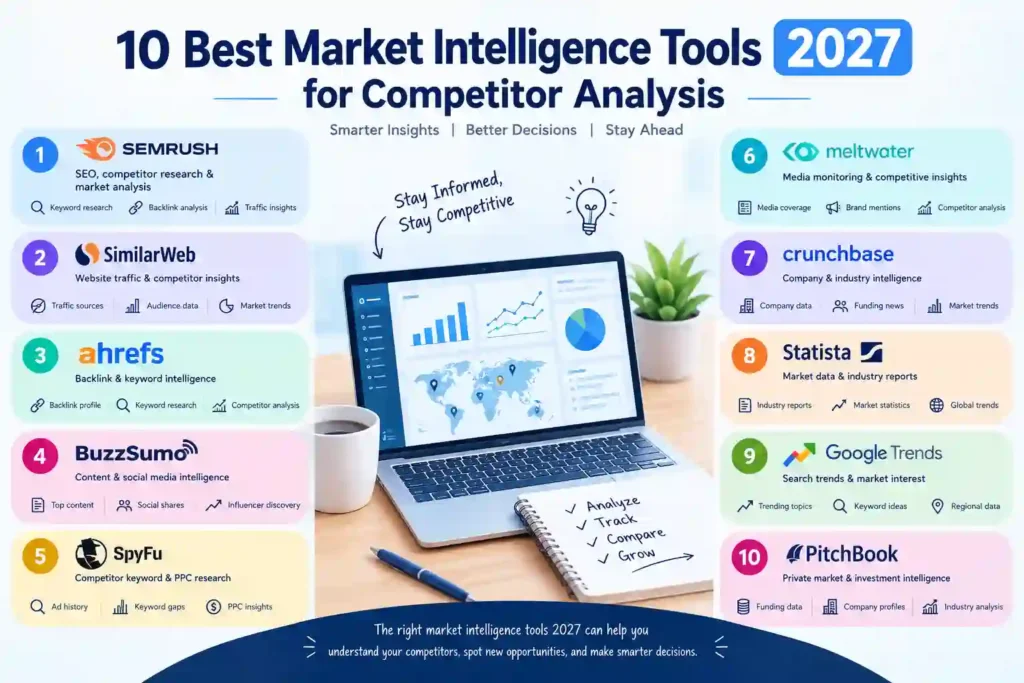
The right market intelligence platform can help you understand competitors, research customer demand, and identify new business opportunities. However, each tool serves a different purpose. Some focus on SEO and website traffic, while others specialize in consumer research, market trends, or industry data.
Here are the first five tools to consider when building your market research strategy.
1. Semrush
Best for: Competitor SEO analysis, keyword research, and digital marketing intelligence.
Semrush is a popular digital marketing platform that helps businesses research competitors and improve their online visibility. It provides tools for keyword research, backlink analysis, website traffic estimates, advertising research, and content optimization.
Key features
- Organic Research: Explore competitors’ estimated organic search visibility and ranking keywords.
- Keyword Overview: Evaluate search volume, keyword difficulty, and other available keyword metrics.
- Backlink Analytics: Review competitor backlink profiles and discover potential link-building opportunities.
- Advertising Research: Investigate available data about competitors’ paid search campaigns.
- Traffic Analytics: Explore estimated website traffic sources and audience behavior metrics where supported by the selected plan.
Pros
- Offers several digital marketing research tools in one platform.
- Helps identify competitor keywords and content opportunities.
- Supports SEO, PPC, and content marketing workflows.
- Provides reports that can help organize competitor research.
Cons
- Advanced features can require a relatively expensive subscription.
- Traffic estimates may differ from actual website analytics.
- New users may need time to understand the available reports and metrics.
Pricing: Semrush offers different subscription options, with pricing and feature limits depending on the plan. Check its official pricing page for current rates and regional availability.
2. Similar web
Best for: Website traffic analysis, digital market research, and competitor benchmarking.
Similar web helps businesses understand digital competition by providing estimates of website traffic, referral sources, audience engagement, and other online performance indicators.
The platform can help you investigate how people discover competitor websites and which channels may contribute to their online visibility. These insights can support decisions about marketing investments, audience targeting, and competitive positioning.
Key features
- Website Traffic Analysis: Explore estimated visits and traffic trends.
- Traffic Sources: Investigate organic search, paid search, direct visits, referrals, and other available channels.
- Competitor Benchmarking: Compare digital performance across selected websites.
- Audience Insights: Examine available audience characteristics and engagement metrics.
- Industry Research: Explore digital market trends and competing websites within relevant categories.
Pros
- Useful for comparing digital competitors.
- Helps identify potential referral and acquisition channels.
- Supports market research beyond individual keyword rankings.
- Offers industry-level insights for competitive benchmarking.
Cons
- Traffic figures are estimates, not exact analytics data.
- Smaller websites may have limited data availability.
- Some advanced research features require paid access.
Pricing: Similar web offers different products and access levels. Availability, features, and pricing depend on the product and subscription arrangement, so consult its official website for current details.
3. Ahrefs
Best for: SEO competitor research, backlink analysis, and content opportunities.
Ahrefs is an SEO research platform that helps businesses analyze websites, discover search keywords, study backlinks, and investigate competing content.
It is especially useful for content marketers and SEO specialists who want to understand why competing websites perform well in search results. By examining competitor pages and referring domains, you can identify opportunities to improve your own content and backlink strategy.
Key features
- Site Explorer: Analyze a website’s backlink profile and estimated organic search performance.
- Keywords Explorer: Research keyword ideas, search demand, and keyword difficulty metrics.
- Content Explorer: Discover relevant content and investigate its performance across available metrics.
- Site Audit: Identify technical SEO issues on websites you manage.
- Rank Tracker: Monitor search rankings for selected keywords where supported by your plan.
Pros
- Provides detailed backlink research capabilities.
- Helps identify competitor keywords and content gaps.
- Supports technical SEO and ongoing ranking analysis.
- Useful for building evidence-based content strategies.
Cons
- Advanced research may require a paid plan.
- Credit limits and feature restrictions can affect usage.
- Some metrics rely on estimates rather than first-party analytics.
Pricing: Ahrefs provides different subscription options and feature limits. Review its official pricing page for current plans and usage allowances.
4. Buzz Sumo
Best for: Content intelligence, topic research, and competitor content monitoring.
Buzz Sumo helps marketers discover popular content, research industry topics, identify influential publishers, and monitor selected brands or subjects.
Key features
- Content Discovery: Find articles and other content related to specific subjects.
- Content Analysis: Investigate available engagement metrics for selected content.
- Trending Topics: Discover subjects receiving attention across supported sources.
- Monitoring: Track selected keywords, brands, or topics where supported.
- Influencer Research: Identify relevant creators and publishers for outreach campaigns.
Pros
- Helps generate content ideas based on existing material.
- Supports competitor content research.
- Can help identify relevant publishers and potential outreach opportunities.
- Useful for editorial planning and content monitoring.
Cons
- Engagement figures do not necessarily represent purchase intent or business results.
- Available data and platform coverage may vary.
- Advanced features can require a paid subscription.
Pricing: Buzz Sumo offers paid plans and may provide limited trial or access options depending on current terms. Check its official website for up-to-date pricing.
5. Statista
Best for: Industry statistics, market research, and business presentations.
Statista is a data and statistics platform that provides access to published statistics, reports, charts, and market information across many industries.
However, always review the original source, publication date, geographic coverage, and methodology before relying on a statistic.
Key features
- Industry Statistics: Explore published data across various sectors.
- Market Insights: Research selected market trends and business developments.
- Reports and Studies: Access available industry research and analytical reports.
- Charts and Visualizations: Find visual representations of selected statistics.
- Consumer Research: Investigate available information about consumer preferences and behavior.
Pros
- Covers a wide range of industries and research topics.
- Can save time when collecting background statistics.
- Provides useful material for reports and presentations.
- Helps support business decisions with published research.
Cons
- Some reports and detailed datasets require paid access.
- Data quality and methodology depend on the original source.
- A published statistic may not reflect the latest market conditions.
- Broad market figures may not accurately describe a small local audience.
Pricing: Access depends on the specific statistic, report, or subscription option. Check the official website to confirm whether the information you need is freely available or requires payment.
5 More Best Market Intelligence Tools to Consider in 2027
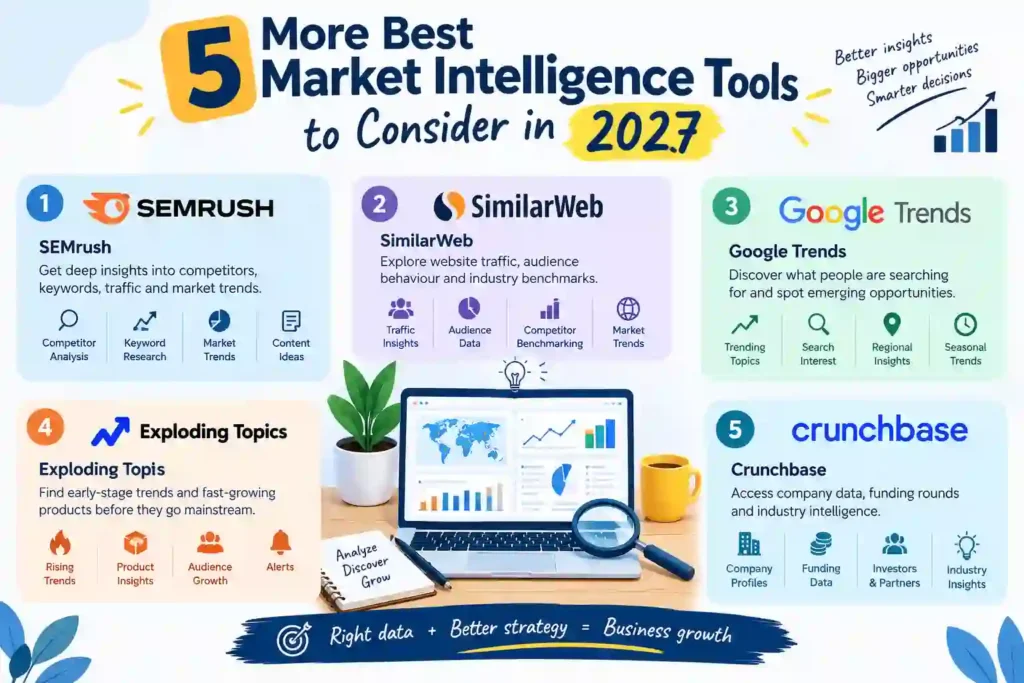
The first five platforms focus on digital competition, SEO research, content intelligence, and industry statistics. However, businesses may need additional insights into consumer behavior, customer feedback, market trends, and industry developments.
6. Google Trends
Best for: Search interest, emerging topics, and market trend analysis.
Google Trends is a free research tool that helps you explore how interest in particular search terms changes over time. You can compare topics, investigate regional interest, and discover related searches.
Key features
- Search Interest Over Time: Explore changes in interest across selected periods.
- Regional Interest: Identify locations where a topic receives relatively high search interest.
- Topic Comparison: Compare the popularity patterns of different search terms or topics.
- Related Queries: Discover associated searches and potential content ideas.
- Trending Searches: Explore emerging search activity in supported regions.
Pros
- Free and accessible to most users.
- Helps identify seasonal patterns and emerging interests.
- Useful for keyword research and content planning.
- Supports comparisons across topics and regions.
Cons
- Does not provide exact search volumes for every query.
- Search interest does not necessarily indicate sales demand.
- Results can be less informative for very specific or low-volume topics.
Pricing: Google Trends is free to use.
7. Brand watch
Best for: Social listening, consumer intelligence, and brand monitoring.
Brand watch helps organizations understand online conversations and consumer opinions through social listening and consumer intelligence capabilities.
These insights can help marketing and customer experience teams make more informed decisions. However, online conversations represent only part of the market, so businesses should combine social listening with other research methods.
Key features
- Social Listening: Monitor relevant conversations across supported online sources.
- Brand Monitoring: Track mentions of selected brands, products, or topics.
- Sentiment Analysis: Examine estimated positive, negative, or neutral attitudes in collected conversations.
- Consumer Insights: Investigate recurring themes and audience interests.
- Trend Monitoring: Identify changes in discussions around relevant topics.
Pros
- Helps businesses understand public conversations about their brands.
- Supports reputation monitoring and campaign analysis.
- Can reveal customer concerns and product feedback.
- Useful for research across large volumes of online discussions.
Cons
- Enterprise-level capabilities may exceed a small business’s budget.
- Automated sentiment analysis can misinterpret context or sarcasm.
- Social conversations may not represent the entire target audience.
- Available sources and features depend on the product and subscription.
Pricing: Brand watch generally targets organizations that need advanced consumer intelligence and social listening. Pricing and package availability should be confirmed directly with the company.
8. Exploding Topics
Best for: Discovering emerging trends and potential market opportunities.
Exploding Topics helps users discover topics, products, and industries that may be gaining attention. It can support early-stage market research by highlighting subjects worth investigating before a business invests in a new product or content strategy.
The platform is particularly relevant to marketers, entrepreneurs, publishers, and product teams that want to explore emerging opportunities.
Key features
- Trend Discovery: Explore topics that are gaining attention.
- Trend Analysis: Examine available historical interest and growth indicators.
- Category Research: Investigate trends across supported industries.
- Product Discovery: Explore products and business ideas attracting interest.
- Trend Monitoring: Follow relevant subjects where supported by the selected plan.
Pros
- Helps generate ideas for new content and products.
- Supports early-stage opportunity research.
- Can complement keyword research and customer surveys.
- Provides a starting point for investigating emerging markets.
Cons
- A growing trend does not guarantee long-term demand.
- Some insights may require a paid subscription.
- Businesses still need to evaluate competition, costs, and customer needs.
- Predictions and trend estimates may not match actual future demand.
Pricing: Exploding Topics offers different access options, and its paid features may vary. Check the official website for current plans and pricing.
Example use case: An entrepreneur wants to start a business selling productivity products. Exploding Topics can help identify growing subjects related to productivity and workplace technology. The entrepreneur can then validate promising ideas through customer interviews, competitor analysis, and market research.
9. Answer The Public
Best for: Customer question research, search intent, and content planning.
Answer The Public helps marketers discover questions and phrases that people search for around a particular topic. This information can reveal customer concerns, common questions, and potential gaps in existing content.
The platform is especially helpful for content teams that want to understand how people describe their problems and what information they need before making a purchase.
Key features
- Question Research: Discover questions associated with a topic.
- Keyword Suggestions: Explore related search phrases and variations.
- Search Intent Ideas: Investigate the information users may seek through their queries.
- Content Planning: Turn relevant questions into blog posts, guides, and FAQ sections.
- Topic Expansion: Find related subjects for broader content coverage.
Pros
- Helps identify real-world questions for content planning.
- Supports long-tail keyword discovery.
- Useful for creating FAQs and educational articles.
- Can help writers develop more reader-focused content.
Cons
- Does not replace a complete competitor intelligence platform.
- Search suggestions do not always provide accurate demand estimates.
- Usage limits and access to advanced features depend on the plan.
- Suggested topics still require relevance and competition checks.
Pricing: Answer The Public provides different access and subscription options. Verify current pricing and search limits on its official website.
Example use case: Suppose you want to write an article about website management for small businesses. You can research questions related to website maintenance, security, performance, and costs. These questions can help you plan useful subheadings and FAQs without forcing keywords into the article.
10. Meltwater
Best for: Media intelligence, brand monitoring, and industry news analysis.
Meltwater provides media intelligence and monitoring solutions that help organizations track news coverage, brand mentions, and relevant conversations across supported sources.
Companies can use the platform to understand how the media discusses their industry, monitor competitors’ public visibility, and identify developments that may affect their reputation or marketing strategy.
Its capabilities are particularly relevant to public relations teams, communications professionals, and larger organizations that need ongoing media monitoring.
Key features
- Media Monitoring: Track relevant news coverage and mentions.
- Brand Monitoring: Monitor selected brands, competitors, and industry topics.
- Media Intelligence: Investigate coverage patterns and media visibility.
- Reporting: Organize findings into reports for internal teams.
- Trend Identification: Follow developments in relevant industries and public discussions.
Pros
- Helps teams monitor relevant media coverage.
- Supports public relations and reputation management.
- Can provide useful context about competitors and industry developments.
- Offers monitoring and reporting capabilities for ongoing research.
Cons
- Advanced capabilities may be costly for smaller businesses.
- Media coverage does not capture every customer opinion or market condition.
- Monitoring results depend on available sources and selected search terms.
- Teams must review findings carefully to distinguish important developments from irrelevant mentions.
Pricing: Meltwater generally offers business-focused solutions with pricing based on the organization’s requirements. Contact the company for a current quote and available features.
Market Intelligence Tools Comparison Table
Choosing between market intelligence platforms becomes easier when you compare their main strengths, ideal users, and pricing options. The following table summarizes the 10 tools discussed in this guide.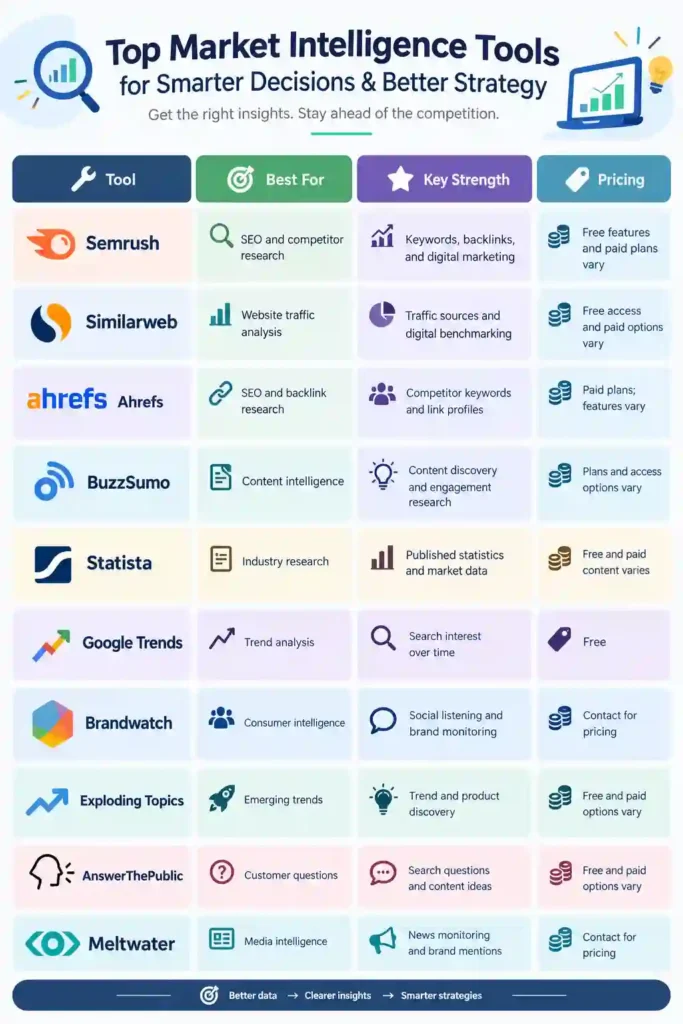
Note: Pricing, free access, feature availability, and usage limits can change. Check each provider’s official website before purchasing a subscription.
How to Choose the Best Market Intelligence Tools 2027 for Your Business
The best tool depends on your business objectives, available budget, and the type of information you need. Rather than paying for several overlapping subscriptions, start with one primary research goal and expand your toolkit when necessary.
- For SEO and Competitor Analysis: Choose Semrush or Ahrefs if you want to research competitor keywords, backlinks, organic search performance, and content opportunities.
- For Website Traffic and Digital Competition: Similar web is worth considering when you want to investigate estimated website traffic, acquisition channels, and digital competitors.
- For Content Marketing and Customer Questions: Buzz Sumo and Answer The Public serve different but complementary purposes.
- Buzz Sumo helps you discover content and investigate available engagement signals. Answer The Public helps you explore questions and related search phrases that can inspire useful articles, guides, and FAQs.
- For Market Trends and Industry Statistics: Google Trends helps you investigate changing search interest, while Statista provides published statistics and industry information. You can combine them to explore potential trends and find supporting data, then validate your conclusions using additional sources.
- For Consumer Intelligence and Media Monitoring: Brand watch is suitable for organizations that need social listening and consumer insights. Meltwater is a better fit when media monitoring and communications intelligence are priorities.
- For Emerging Business Opportunities: Exploding Topics can help you discover subjects and products worth investigating. Use it as an early research step rather than proof that a business opportunity will succeed. Before investing, assess customer demand, competition, operating costs, and potential profitability.
Practical Tips for Getting More Value From Market Intelligence Tools
Buying a platform is only the first step. To make better decisions, create a consistent research process and connect your findings to measurable business goals.
- Define your research objective. Decide whether you want to improve SEO, understand customers, monitor competitors, or investigate a new market.
- Select relevant competitors. Focus on businesses that target similar customers or compete for the same search visibility. Direct competitors and search competitors are not always the same.
- Establish a baseline. Record useful starting metrics, such as estimated traffic, ranking keywords, customer sentiment, or search interest. Use the metrics that match your objective.
- Monitor changes consistently. Review important indicators weekly or monthly, depending on how quickly your market changes. Avoid reacting to every short-term fluctuation.
- Verify important findings. Third-party traffic estimates, trend indicators, and automated sentiment analysis can contain limitations. Cross-check important insights with reliable sources and your own business data.
- Turn research into action. Use your findings to improve content, adjust campaigns, investigate customer concerns, or test new product ideas.
- Measure the results. Track whether your decisions improve relevant outcomes, such as organic traffic, qualified leads, conversion rates, or customer retention.
A clear process helps you use Market Intelligence Tools 2027 for meaningful improvements rather than collecting reports without a specific purpose.
Frequently Asked Questions About Market Intelligence Tools
1. What are the best Market Intelligence Tools 2027?
The best option depends on your research goals. Semrush and Ahrefs are useful for SEO competitor analysis, Similar web supports digital traffic research, Buzz Sumo helps with content intelligence, and Google Trends provides search interest data. Brand watch and Meltwater serve more specialized consumer and media intelligence needs.
2. Are market intelligence tools free?
Some tools offer free access or limited free features. Google Trends is free, while other platforms may restrict searches, reports, data access, or advanced features to paid plans. Review the current terms before choosing a tool.
3. What is the difference between market intelligence and competitive intelligence?
Market intelligence covers the broader business environment, including customers, industry trends, market demand, and competitors. Competitive intelligence focuses more specifically on rival businesses, their strategies, products, positioning, and activities.
4. Which market intelligence software is best for small businesses?
Small businesses can start with Google Trends for trend research and a suitable SEO platform for competitor analysis. Semrush, Ahrefs, and Similarweb may be useful when their available features match the business’s needs and budget.
5. How do Market Intelligence Tools 2027 help with SEO?
These platforms can help you discover competitor keywords, research search trends, identify content gaps, and understand backlink opportunities. You can use these insights to create relevant content and improve your SEO strategy.
However, no tool guarantees higher rankings. Results also depend on content quality, technical SEO, competition, and other ranking factors.
6. Can Market Intelligence Tools 2027 predict future market trends?
Some platforms identify emerging trends or estimate how interest may develop. However, these insights cannot guarantee future outcomes. Businesses should combine trend data with customer research, industry knowledge, and careful testing before making major investments.
7. How often should businesses conduct market intelligence research?
The ideal frequency depends on the industry and business objective. A digital marketing team might review SEO and competitor changes weekly or monthly, while a business researching a new market may conduct a more detailed analysis before launching a product.
8. What should I consider before buying market intelligence software?
Evaluate the platform’s data sources, accuracy limitations, relevant features, pricing, ease of use, reporting capabilities, and integration options. Also, consider whether your team can turn the information into practical business decisions.
Conclusion
The best Market Intelligence Tools 2027 help businesses understand competitors, investigate customer needs, monitor industry developments, and discover opportunities for growth. However, no single platform meets every research requirement.
Semrush and Ahrefs are strong candidates for SEO competitor analysis, Similarweb supports digital market research, and BuzzSumo helps marketers explore content opportunities. Google Trends offers a free way to investigate search interest, while Statista can support industry research. Brandwatch, Exploding Topics, AnswerThePublic, and Meltwater address additional needs related to consumer intelligence, emerging trends, customer questions, and media monitoring.