Real Estate Email Marketing Finding new clients is one of the biggest challenges for real estate agents. You may have attractive property listings, an active social media presence, and a professional website, but turning interested visitors into serious buyers still takes time. This is where real estate email marketing can make a difference.
Email gives you a direct way to stay connected with potential buyers, homeowners, sellers, and previous clients. Instead of waiting for people to revisit your website, you can share useful property updates, local market news, open house invitations, and helpful advice directly in their inboxes.
What Is Real Estate Email Marketing?
Real estate email marketing is the practice of sending relevant emails to potential buyers, sellers, homeowners, and past clients to share property information, provide useful advice, promote services, and maintain relationships.
Unlike broad advertising, estate email marketing allows you to communicate directly with people who have subscribed to your updates or otherwise agreed to receive your messages. You can tailor the content according to their interests, location, stage in the buying or selling process, and previous interactions with your business.
For example, a first-time buyer may appreciate mortgage preparation tips, while a homeowner preparing to sell may prefer information about property valuations and local market trends. Sending each person relevant information makes your communication more useful.
How Email Marketing Works for Real Estate Agents
The process usually begins when someone joins your estate email marketing list through a website form, property inquiry, open house registration, or another appropriate opt-in method. You can then organize subscribers into groups and send emails that match their needs.
A typical process includes:
- Build your email list: Collect contact details from people who have agreed to receive your communications.
- Understand subscriber interests: Identify whether contacts are buyers, sellers, investors, or previous clients.
- Create relevant emails: Share property listings, market updates, invitations, or educational content.
- Include a clear next step: Invite readers to view a listing, schedule a consultation, or request more information.
- Review performance: Track clicks, inquiries, conversions, and unsubscribes to understand what works.
For instance, if someone requests information about a home, you could send the property details first and follow up with an invitation to schedule a viewing. This approach keeps the conversation helpful rather than overly promotional.
Always follow applicable estate email marketing and privacy laws, including consent and unsubscribe requirements.
Why Email Marketing Matters for Real Estate Agents
Real estate decisions often take weeks or months. Buyers may compare several properties before making an offer, while sellers may wait for the right market conditions. Regular, relevant emails help agents remain visible during this decision-making process.
Email can also support long-term relationships. A previous client might recommend your services to a friend or contact you again when they are ready to move. Sharing useful homeownership advice and occasional market updates gives people a reason to remember your business.
What Are the Benefits of Real Estate Email Marketing?
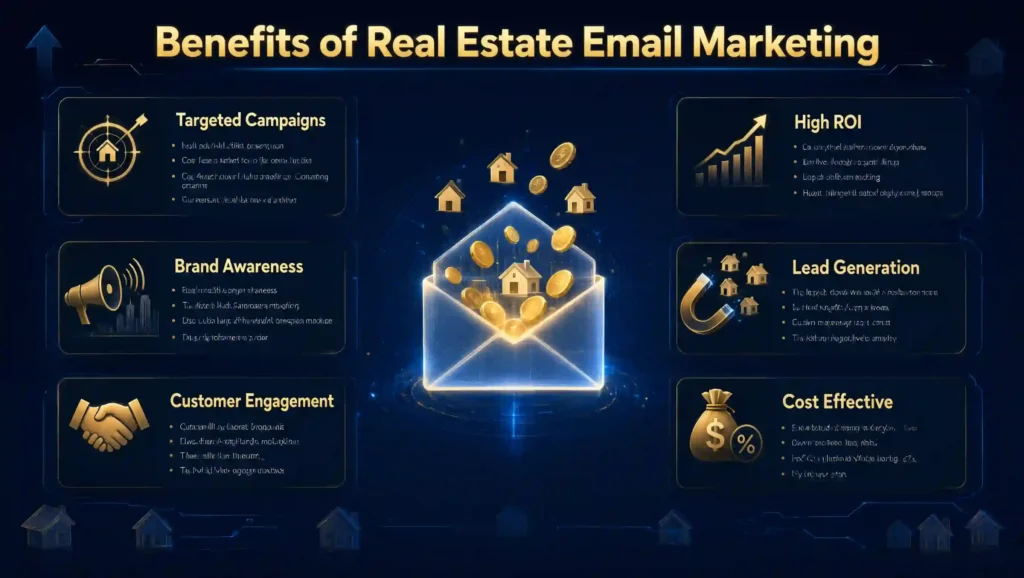
A well-planned email strategy can help real estate professionals communicate consistently without depending entirely on paid advertising or social media algorithms. Its value comes from reaching the right people with information that supports their decisions.
- Generate More Qualified Real Estate Leads: estate email marketing campaigns can encourage interested people to take meaningful actions, such as requesting property details, booking a viewing, or arranging a consultation. By sending information based on subscriber interests, you can attract inquiries from people who are more likely to need your services.
- Build Trust With Potential Clients: Buying or selling a property is a major financial decision. Helpful emails can demonstrate your knowledge of the local market and answer common questions before a client contacts you.
- Stay Connected With Past Clients: Your relationship with a client does not have to end after a transaction closes. Occasional updates about property maintenance, local market changes, and homeownership can keep your business familiar to former clients.
- Promote Property Listings Efficiently: estate email marketing provides a convenient way to share new listings with subscribers whose preferences match the available properties. You can include key features, price information, location details, photographs, and a link to the complete listing.
- Measure and Improve Campaign Results: Most estate email marketing platforms provide reports on delivery, clicks, unsubscribes, and other campaign activity. These measurements can help you identify which messages attract attention and which need improvement.
11 Real Estate Email Marketing Strategies to Generate More Leads
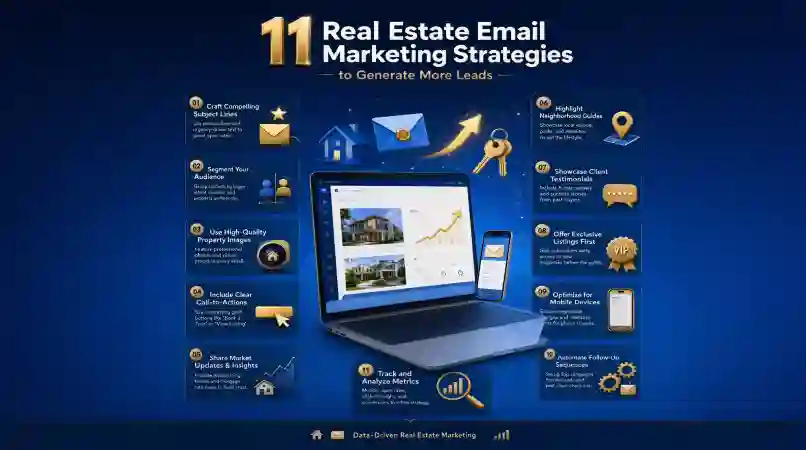
A successful real estate email marketing strategy starts with understanding what your audience needs. Some subscribers want to buy a home soon, while others are researching the market or preparing to sell. Sending relevant messages to each group helps you build stronger relationships and encourage meaningful responses.
The following 11 strategies can help real estate agents create more useful campaigns, maintain contact with prospects, and identify opportunities to grow their businesses.
1. Build a Targeted Email List for Real Estate Leads
A quality email list is more valuable than a large list filled with people who have little interest in your services. Focus on attracting subscribers who want property updates, home-buying guidance, selling advice, or information about their local market.
You can encourage people to subscribe through your real estate website, property listing pages, open house registration forms, and downloadable home-buying guides. Explain what subscribers will receive so they understand the value of joining your list.
For example, you could offer a monthly neighborhood property report that includes recent listings, local market trends, and practical homeownership advice.
Keep these points in mind:
- Use clear signup forms on relevant website pages.
- Explain the type and frequency of emails subscribers can expect.
- Collect only the personal information you genuinely need.
- Obtain appropriate consent and make unsubscribing easy.
- Remove invalid addresses and manage inactive contacts responsibly.
Avoid buying random estate email marketing lists. These contacts may not have agreed to hear from you, which can damage your sender reputation and create legal or compliance problems.
2. Personalize Email Marketing for Real Estate Agents
Personalization helps make emails more relevant to individual subscribers. However, it involves more than adding someone’s first name to the greeting. The most useful approach is to tailor the message to their property interests, location, and stage in the real estate journey.
For example, a first-time buyer may appreciate a guide to preparing for a mortgage application. Someone interested in selling may prefer information about property valuations, preparing a home for sale, and understanding local market conditions.
You can personalize messages by using:
- Preferred neighborhoods or property locations.
- Budget ranges and property types, when voluntarily provided.
- Previous inquiries or listing interactions.
- Buying, selling, or homeownership interests.
- Relevant local events and market updates.
Keep personalization accurate and respectful. Do not make assumptions about someone’s finances or personal circumstances based on limited information.
A helpful email might begin with a short introduction to three properties that match a subscriber’s stated preferences, followed by links to view the listings or arrange a viewing.
3. Create a Successful Real Estate Email Marketing Campaign
Every real estate email marketing campaign should have a clear purpose. Before writing your message, decide what you want subscribers to learn or do. Your goal might be to promote a new property, invite people to an open house, share a local market report, or encourage potential sellers to request a consultation.
A strong campaign usually includes four elements:
- A relevant audience: Send the message to subscribers who are likely to find it useful.
- A clear subject line: Explain the main benefit or topic without misleading readers.
- Useful content: Include accurate property details, practical advice, or meaningful updates.
- One primary call to action: Tell readers what to do next, such as viewing a listing or booking a consultation.
For example, an agent promoting a new property could send an email titled “New Homes in [Neighborhood]: See the Latest Listings.” The message could briefly describe the available properties and link to a page with photographs, prices, and viewing details.
You can also test different subject lines, email layouts, and calls to action. Change one element at a time where possible so you can better understand what influences the results.
4. Promote Property Listings Through Email
Property listing emails help subscribers discover homes that match their interests without having to search your website repeatedly. They work best when the properties are relevant and the information is accurate.
Instead of sending a long list of every available property, select a few listings that fit the audience’s stated preferences. Include clear photographs, the asking price, location, property type, key features, and a link to the full listing.
For instance, buyers interested in two-bedroom homes could receive a short email featuring three suitable properties in their preferred area. Each listing could include a brief description and a button or text link to view more details.
To improve listing emails:
- Use high-quality, relevant property photographs.
- Make prices and important property details easy to find.
- Link to the complete listing or viewing request page.
- Update or remove listings that are no longer available.
- Use accurate, inclusive property descriptions.
- Avoid sending the same listing repeatedly without a useful reason.
You should also make sure that your property information complies with applicable real estate advertising and fair housing requirements.
5. Send Welcome Emails to New Subscribers
A welcome email introduces your business and sets expectations for future communication. Because new subscribers have recently expressed interest, this is a useful opportunity to explain how your emails can help them.
Start by thanking the subscriber for joining. Briefly introduce your real estate services and explain the information they can expect, such as property listings, neighborhood updates, or buying and selling advice.
A simple welcome email could look like this:
Subject: Welcome! Get Helpful Real Estate Updates
Hi [First Name],
Thank you for subscribing to our real estate updates. We share useful property listings, local market news, and practical advice to help you make informed decisions.
If you are looking for a home in a particular area or preparing to sell your property, you can reply to this email and tell us what information would be most helpful.
We look forward to keeping you informed.
Best regards,
[Agent Name]
After the welcome email, you can send a short sequence of relevant messages over time. For example, the next email might introduce a local neighborhood guide, followed by a useful home-buying or selling resource.
Avoid sending too many messages at once. Let subscribers become familiar with your business at a comfortable pace.
6. Share Local Real Estate Market Updates
Local market updates give subscribers information that can help them understand property activity in their area. They can include recent sales, changes in listing inventory, asking-price trends, or information about neighborhoods and local amenities.
For example, a monthly newsletter might highlight the number of new listings in a particular area, summarize recent comparable sales, and link to current properties on the market.
Make your updates useful by explaining what the data means rather than simply presenting numbers. A buyer may want to understand how changing inventory affects their search, while a homeowner may be interested in recent comparable sales.
When creating market update emails:
- Use recent, reliable local data.
- State the location and period covered.
- Explain important terms in plain English.
- Link to relevant listings or supporting resources.
- Avoid promising that prices will rise or fall.
- Clearly distinguish historical data from forecasts.
Useful market updates can position you as a knowledgeable local resource without turning every email into a direct sales pitch.
7. Follow Up With Open House Visitors
An open house gives potential buyers an opportunity to explore a property, ask questions, and decide whether it meets their needs. A thoughtful follow-up email can continue that conversation after the visit.
Send a timely message thanking visitors for attending. If appropriate, provide a link to the property details, answer questions they raised, or offer information about similar homes.
For example:
Subject: Thanks for Visiting [Property Address]
Hi [First Name],
Thank you for visiting the property at [Property Address]. I hope the viewing helped you understand whether it could be a good fit for your needs.
If you would like more information about the property or want to arrange another viewing, feel free to reply to this email.
If this home was not quite right, I can also share other listings based on the preferences you have provided.
Best regards,
[Agent Name]
Keep the message friendly and avoid pressuring visitors to make a quick decision. If someone has expressed interest in another property, make the next communication relevant to that interest.
8. Automate Real Estate Email Campaigns
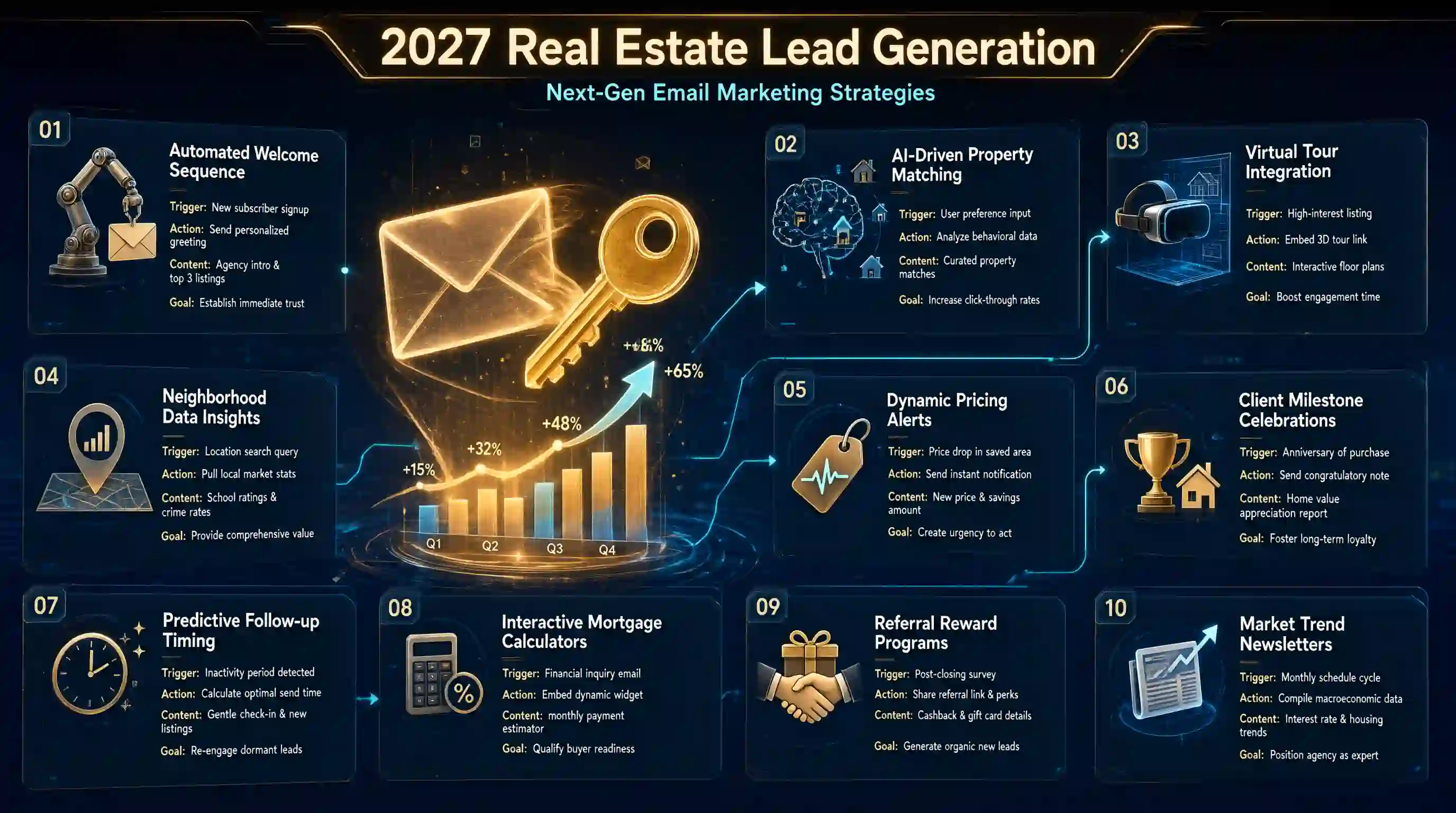
Email automation allows you to send planned messages in response to specific actions or at appropriate stages of the client journey. It can save time while helping you maintain consistent communication.
For example, when a subscriber requests a neighborhood guide, an automated workflow could deliver the guide and later share a related market update. Someone who registers for an open house could receive a confirmation and, where appropriate, a follow-up message.
Useful automation workflows include:
- Welcome emails for new subscribers.
- Follow-ups after property inquiries.
- New listing alerts based on subscriber preferences.
- Open house confirmations and follow-ups.
- Periodic homeowner newsletters.
- Re-engagement messages for inactive subscribers.
Choose automation rules carefully. Make sure the emails are triggered by appropriate actions and that subscribers receive messages relevant to their interests.
Review your workflows regularly to remove outdated property details, broken links, and unnecessary messages. Provide an easy way to unsubscribe and honor subscriber preferences.
Automation should support genuine communication, not replace the personal attention that many real estate clients need.
9. Share Client Testimonials and Success Stories
Testimonials and success stories can help prospective clients understand what working with your business may be like. They can also demonstrate how you support buyers and sellers throughout a transaction.
For example, you might share a client’s experience of finding a suitable home, explain how you helped a seller prepare a property for the market, or describe how you kept a buyer informed during the purchasing process.
Keep these emails credible and informative:
- Obtain permission before publishing a client’s testimonial.
- Use authentic feedback rather than fabricated quotations.
- Explain the situation and your role clearly.
- Avoid guaranteeing that every client will achieve the same result.
- Include a relevant next step, such as booking a consultation.
You can also share educational stories that explain common challenges and how clients can prepare for them. These messages provide value while helping readers understand your approach.
10. Reconnect With Inactive Real Estate Leads
Some subscribers stop opening emails because their plans change, they become busy, or the information no longer matches their interests. A respectful re-engagement campaign can help you determine whether they still want to receive your updates.
Start with a short message that acknowledges the gap and offers something useful. You could ask whether the subscriber would prefer property alerts, market news, or occasional educational content.
For example:
Subject: Would You Like to Keep Receiving Real Estate Updates?
Hi [First Name],
I wanted to check whether our real estate updates are still useful to you.
If you are still exploring the market, we can share relevant property listings, local updates, or home-buying and selling resources. You can also update your preferences to receive only the information that interests you.
If you no longer wish to receive these emails, you can unsubscribe at any time using the link below.
Best regards,
[Agent Name]
Avoid repeatedly emailing people who do not respond. Set a reasonable re-engagement process, honor unsubscribe requests, and suppress contacts who should no longer receive marketing messages.
11. Test Email Subject Lines and Send Times
Small improvements in your email campaigns can make your messages clearer and more useful. Testing helps you learn which approaches work best for your particular audience instead of relying on assumptions.
Begin with subject lines. A subject line should explain the email’s main value without exaggeration. For example, compare “New Listings in [Neighborhood]” with “Explore Three New Homes in [Neighborhood].” The best option depends on your audience and the content of the message.
You can also test:
- Different calls to action.
- Short versus detailed email copy.
- One prominent property versus several listings.
- Email layouts on mobile devices.
- Different sending times and days.
- Personalized content versus general updates.
Use A/B testing when your email platform supports it. Test one major element at a time and use a suitable sample size before drawing conclusions.
Do not judge a campaign only by its open rate. Privacy features and automated email activity can make opens less reliable. Review click-throughs, inquiries, qualified leads, conversions, unsubscribes, and other outcomes that match your campaign’s goal.
Over time, these insights can help you refine your real estate email marketing approach and make future campaigns more relevant to subscribers.
Email Templates for Real Estate Agents
Ready-to-use email templates can help real estate agents save time and communicate more consistently with potential buyers, sellers, and previous clients. However, the best email templates for real estate agents should feel personal rather than generic. Adapt each message to the recipient’s interests, the property’s details, and the action you want them to take.
Here are four practical examples you can customize for your business.
New Property Listing Email Template
Use this email when a property becomes available and matches the interests of subscribers on your list. Include accurate details and a direct link to the complete listing.
Subject: New Property Available in [Neighborhood]
Hi [First Name],
I wanted to share a new property in [Neighborhood] that may interest you.
Property highlights:
- Location: [Property Address or Neighborhood]
- Price: [Asking Price]
- Bedrooms and bathrooms: [Number]
- Key features: [Relevant Property Features]
You can view the photos, full details, and available viewing information here: [Property Link].
Would you like to arrange a viewing or learn more about this property? Simply reply to this email, and I will be happy to help.
Best regards,
[Agent Name]
[Real Estate Business]
[Contact Information]
Why it works: The email presents the most important information clearly and gives interested buyers a simple next step. Only send this message to subscribers for whom the property is relevant.
Open House Invitation Email Template
An open house invitation helps interested buyers learn when they can visit a property. Make the date, time, location, and registration instructions easy to find.
Subject: You’re Invited: Open House at [Property Address]
Hi [First Name],
Are you exploring homes in [Neighborhood]? I would like to invite you to an upcoming open house at [Property Address].
Event details:
- Date: [Date]
- Time: [Start and End Time]
- Location: [Property Address]
- Featured highlights: [Two or Three Key Features]
This is an opportunity to explore the property, view its layout, and ask questions about the home.
If you would like to attend, please [Register Here or Reply to This Email].
I hope to see you there!
Best regards,
[Agent Name]
[Contact Information]
Why it works: The invitation provides the information visitors need and makes the next step straightforward. Send a reminder only when appropriate and consistent with the recipient’s communication preferences.
Follow-Up Email Template for Potential Buyers
A follow-up email can continue the conversation after a property inquiry or viewing. Instead of immediately pushing for a decision, offer useful information and invite the buyer to share their thoughts.
Subject: Any Questions About [Property Address]?
Hi [First Name],
Thank you for your interest in [Property Address]. I wanted to check whether you had any questions about the property or would like additional information.
If this home does not fully match your needs, I can also help you explore other options based on your preferred location, budget, and property features.
Would you prefer to arrange another viewing or receive details about similar listings?
Feel free to reply whenever it is convenient for you.
Best regards,
[Agent Name]
[Contact Information]
Why it works: The message keeps communication open without pressuring the buyer. It also helps you understand whether the person needs more information or would benefit from different property suggestions.
Real Estate Market Update Email Template
A market update email provides subscribers with useful local information and helps them make more informed property decisions. Use verified data from a reliable local source and clearly state the period it covers.
Subject: [Month] Real Estate Market Update for [Area]
Hi [First Name],
Here is your latest update on the real estate market in [Area].
This month’s highlights:
- New listings: [Verified Figure]
- Recent sales: [Verified Figure]
- Median sale price: [Verified Figure]
- Notable market change: [Brief, Data-Supported Explanation]
These figures offer a snapshot of recent activity in the area. Individual property values and selling times can vary depending on location, condition, demand, and other factors.
If you are considering buying or selling, I can help you explore the information most relevant to your situation.
[View Available Properties or Request a Consultation]
Best regards,
[Agent Name]
[Contact Information]
Why it works: It combines useful information with a relevant next step. Avoid presenting market figures without their dates, sources, or necessary context.
How to Improve Your Real Estate Email Marketing
Creating an email is only the beginning. To improve results, real estate agents need to understand their audience, deliver useful information, and make every message easy to read and act on.
Write Clear and Compelling Subject Lines
Your subject line helps subscribers understand why an email may be worth opening. Keep it concise, specific, and relevant to the message.
For example, “New Listings in [Neighborhood]” is more informative than “Amazing News!” when the email contains property listings. Avoid misleading promises, excessive punctuation, and claims that the content cannot support.
You can test alternative subject lines to discover which ones resonate with your audience. However, remember that email privacy features can make open-rate data less reliable, so evaluate other campaign results as well.
Make Every Email Personal and Useful
Subscribers are more likely to find your emails valuable when the content matches their interests. A buyer searching for an apartment does not necessarily need the same information as a homeowner preparing to sell.
Use subscriber preferences and relevant interactions to tailor the message. You can share property recommendations, local market reports, home preparation tips, or educational resources based on what readers have requested.
Avoid adding personal details simply to make an email appear customized. Personalization should improve relevance while respecting privacy.
Include a Clear Call to Action
A call to action (CTA) tells readers what to do next. Without one, subscribers may read your message but remain unsure how to proceed.
Depending on the campaign, your CTA could invite readers to:
- View a property listing.
- Schedule a home viewing.
- Download a neighborhood guide.
- Request a property valuation.
- Book a consultation with an agent.
Keep the primary action easy to understand. If you include several links, make sure they support the email’s main purpose rather than competing for attention.
Optimize Emails for Mobile Devices
Many subscribers read emails on phones, so your messages should be comfortable to view on smaller screens. Use short paragraphs, readable fonts, clear headings, and appropriately sized images.
Check that buttons and links are easy to tap and that important information is not hidden inside large images. Before sending a campaign, preview it on different screen sizes and test the links.
Send Emails at an Appropriate Frequency
Sending too many messages can frustrate subscribers, while sending too few may cause them to forget your business. The right frequency depends on the content, subscriber preferences, and type of campaign.
For example, a buyer who requests property alerts may welcome relevant listing updates, while a general newsletter subscriber may prefer a monthly email.
Start with a consistent schedule, monitor engagement and unsubscribes, and adjust based on subscriber preferences. Always provide a simple way for people to stop receiving marketing emails.
Real Estate Email Marketing Software: Features to Compare
Real estate email marketing software helps agents organize subscriber lists, design emails, schedule campaigns, and evaluate results. Some platforms also provide automated workflows, signup forms, and integrations with customer relationship management (CRM) systems.
The right choice depends on your contact list, budget, technical experience, and marketing goals. A solo agent may need only simple newsletters and signup forms, while a growing agency may benefit from segmentation, automation, and CRM integration.
Features to Look for in Email Marketing Software
Before selecting a platform, compare the following features:
Contact management and segmentation: Look for tools that let you organize subscribers into relevant groups, such as buyers, sellers, past clients, and people interested in particular neighborhoods.
Email templates and design tools: A drag-and-drop editor can make it easier to create property announcements, newsletters, invitations, and follow-up messages without coding.
Automation: Automated welcome emails, inquiry follow-ups, and scheduled newsletters can reduce repetitive work. Make sure you can control the timing and content of each workflow.
Campaign analytics: Useful reports include delivery information, clicks, conversions where trackable, bounces, and unsubscribes. These insights help you understand how campaigns perform.
Integrations: If you already use a CRM or real estate website, check whether the email platform can connect with your existing tools.
Consent and unsubscribe management: Choose a platform that supports appropriate consent records, suppression lists, and easy unsubscribe handling. You remain responsible for complying with applicable laws.
How to Choose Software for Your Business
Start by listing the tasks you want the software to handle. If you mainly send a monthly newsletter, a simple email platform may be enough. If you manage many active leads, you may need more advanced segmentation and automated follow-ups.
Next, compare pricing, contact limits, sending limits, available features, and ease of use. Check whether the functions you need are included in the plan you can afford, because some platforms charge extra for automation, additional contacts, or advanced reporting.
How to Measure Real Estate Email Marketing Performance
Tracking campaign performance helps you understand whether your emails are attracting attention, generating inquiries, and supporting your business goals. Instead of judging success by the number of emails sent, focus on the actions subscribers take after receiving them.
Most email marketing platforms provide reporting tools that help you evaluate engagement and identify opportunities for improvement. The metrics you prioritize should match the purpose of each campaign.
Email Click-Through Rate
Click-through rate (CTR) measures the percentage of delivered emails that generate at least one click on a link. In real estate email marketing, clicks can show whether subscribers are interested in property listings, neighborhood guides, or consultation pages.
Formula:
Click-Through Rate = (Unique Email Clicks ÷ Delivered Emails) × 100
For example, if 500 delivered emails generate 25 unique clicks, the click-through rate is 5%.
If your CTR is low, review whether the content matches subscriber interests, the links are easy to find, and your call to action clearly explains the next step.
Email Conversion Rate
Conversion rate measures the percentage of email recipients who complete a desired action, depending on how your campaign and tracking system define a conversion. For a real estate agent, this might mean submitting a property inquiry form, booking a consultation, or registering for an open house.
Formula:
Conversion Rate = (Attributed Conversions ÷ Delivered Emails) × 100
For example, if 500 delivered emails lead to 10 tracked consultation bookings, the conversion rate is 2%.
Use appropriate tracking links and website analytics to understand which campaigns contribute to inquiries. Keep in mind that some conversions may involve multiple channels, so attribution is not always straightforward.
Email Bounce Rate
Bounce rate measures the percentage of sent emails that could not be delivered. Hard bounces generally indicate permanent delivery problems, such as an invalid address, while soft bounces may result from temporary issues.
Formula:
Bounce Rate = (Bounced Emails ÷ Emails Sent) × 100
For example, if 1,000 emails are sent and 20 bounce, the bounce rate is 2%.
To reduce avoidable bounces, use legitimate signup methods, correct address-entry errors, and remove invalid addresses. Never use purchased contact lists as a shortcut to growing your audience.
Email Unsubscribe Rate
Unsubscribe rate measures the percentage of recipients who opt out of future emails after a campaign. A sudden increase can indicate that your messages are too frequent, irrelevant, or different from what subscribers expected.
Formula:
Unsubscribe Rate = (Unsubscribes Attributed to the Campaign ÷ Delivered Emails) × 100
For example, if 500 emails are delivered and five recipients unsubscribe, the unsubscribe rate is 1%.
Review the content and frequency of campaigns when this metric rises. Make sure your signup forms clearly describe what subscribers will receive, and honor unsubscribe requests promptly.
Track Qualified Leads and Return on Investment
Email engagement does not always translate into business results. A campaign may generate many clicks but few serious inquiries, so it is important to track qualified leads and completed actions as well.
You can monitor the number of property inquiries, booked viewings, consultation requests, and clients attributed to a campaign. If you can reliably measure the revenue associated with a campaign, compare it with the campaign’s costs to evaluate return on investment (ROI).
Formula:
ROI = ((Attributed Revenue − Campaign Costs) ÷ Campaign Costs) × 100
For example, if a campaign generates $2,000 in attributable revenue and costs $500, its calculated ROI is 300%.
Use realistic attribution methods and include relevant campaign costs. Real estate transactions may take months to complete, so results should be evaluated over an appropriate period.
Common Real Estate Email Marketing Mistakes to Avoid
Even a well-designed campaign can underperform when the message is irrelevant, difficult to read, or sent to the wrong audience. Avoiding these common mistakes can help you maintain subscriber trust and improve your results over time.
- Sending the Same Email to Every Subscriber: Buyers, sellers, investors, and previous clients often need different information. Sending identical messages to everyone can make your emails less useful.
- Using Misleading Subject Lines: An exaggerated subject line may attract attention, but it can damage trust if the email does not deliver what it promises.
- Sending Emails Too Frequently: Frequent promotional messages can overwhelm subscribers and increase unsubscribes. On the other hand, long periods without communication may cause readers to lose interest.
- Ignoring Mobile-Friendly Design: Large images, tiny text, and difficult-to-tap links can make emails frustrating to read on phones.
- Failing to Track Campaign Results: Without performance tracking, it is difficult to know which emails generate meaningful interest.
- Neglecting Email Privacy and Consent: Sending unsolicited marketing emails can harm your reputation and may violate applicable laws.
Frequently Asked Questions About Real Estate Email Marketing
How Do I Improve My Real Estate Email Marketing?
Improve your real estate email marketing by sending relevant content to a clearly defined audience. Segment subscribers according to their interests, write specific subject lines, personalize messages appropriately, and include a clear call to action. Test different campaign elements and monitor clicks, inquiries, conversions, and unsubscribes to understand what works best.
What Is the Best Email Marketing Software for Real Estate?
The best email marketing software depends on your business size, budget, and workflow. Look for contact segmentation, customizable templates, automation, campaign reporting, and integration with your CRM. A solo agent may need a simple newsletter platform, while a larger agency may benefit from advanced automation and lead management. Compare current plans and features before making a decision.
What Type of Marketing Is Best for Real Estate?
There is no single marketing method that works best for every real estate business. Email marketing helps agents nurture leads and maintain client relationships, while search engine optimization can attract people searching online. Social media, property portals, referrals, and open houses can also support lead generation. The right mix depends on your target audience, local market, budget, and business goals.
Conclusion
Real estate email marketing gives agents a practical way to stay connected with potential buyers, sellers, and previous clients. By sharing relevant property listings, local market updates, helpful advice, and timely follow-ups, you can build trust and encourage subscribers to take meaningful next steps.
Start with a targeted email list and a clear campaign goal. Then use personalization, useful templates, appropriate automation, and reliable performance tracking to improve your communication. Choose email marketing software that fits your needs, and always respect subscriber preferences and privacy.