
Artificial intelligence and technology are changing how people work, learn, communicate, and manage businesses. From AI-powered tools to business automation, modern technology helps individuals and organizations complete tasks faster and make better decisions.
The growth of AI and technology has also created new opportunities for small businesses, students, professionals, and entrepreneurs. You no longer need a large technical team to benefit from many digital tools and software solutions.
What Is AI and Technology?
AI and technology refers to the combination of artificial intelligence, software, automation, machine learning, digital tools, and other technologies that help people solve problems and improve everyday tasks.
Artificial intelligence allows computer systems to perform tasks that normally require human intelligence. These tasks can include analyzing information, generating content, recognizing patterns, answering questions, and making predictions.
Technology provides the systems and tools that make these capabilities useful in real-world situations. For example, businesses can use AI software to analyze data, automate repetitive tasks, or improve customer support.
Together, AI and technology are becoming an important part of modern business and everyday life.
Why Is AI and Technology Important?

Technology has always helped people work more efficiently, but artificial intelligence is expanding what digital tools can do.
Businesses can now automate repetitive processes, analyze large amounts of information, and use AI-powered software without building every system from scratch.
Some important benefits include:
- Improved productivity: Technology can reduce the time required for repetitive tasks.
- Better decision-making: AI systems can help analyze data and identify useful patterns.
- Business automation: Automated workflows can handle routine processes with less manual work.
- Faster content creation: AI tools can assist with writing, images, research, and other creative tasks.
- Better customer experiences: Businesses can use software and AI systems to respond to customers more efficiently.
- Access to advanced tools: Small businesses can use technologies that were previously available mainly to larger organizations.
Major Areas of AI and Technology
AI and technology covers a wide range of subjects. Understanding the major areas can help you choose the right tools and solutions for your needs.
AI Tools
AI tools are applications that use artificial intelligence to help users complete specific tasks. They can support writing, research, image creation, productivity, education, marketing, and many other activities.
Different AI tools are designed for different purposes. Some focus on text generation, while others work with images, data, audio, or business processes.
As the AI industry continues to grow, users should compare features, pricing, accuracy, privacy, and ease of use before choosing a tool.
Automation
Automation allows software and digital systems to perform repetitive tasks with limited manual involvement. For businesses, automation can help with tasks such as data entry, email workflows, customer communication, reporting, and scheduling.
Small businesses can particularly benefit from automation because it can reduce repetitive work while allowing employees to focus on more important activities.
Machine Learning
Machine learning is an important area of artificial intelligence. It enables computer systems to learn patterns from data and improve their performance without being programmed for every individual situation.
Machine learning is used in areas such as recommendations, fraud detection, search systems, image recognition, and predictive analytics.
Software
Software provides the digital systems people use to perform specific tasks. Modern software can support almost every area of business and personal productivity. Examples include video editing software, healthcare software, project management platforms, business management systems, and industry-specific applications.
Choosing the right software depends on factors such as features, budget, compatibility, security, and the user’s specific requirements.
Gadgets
Technology is not limited to software. Gadgets such as smartphones, smartwatches, laptops, tablets, and other connected devices are also part of the modern technology ecosystem. Many modern gadgets now include AI-powered features that can improve productivity, communication, photography, accessibility, and entertainment.
How AI and Technology Are Changing Businesses
Businesses of all sizes are adopting new technologies to improve their operations. AI can help organizations analyze information, automate workflows, improve customer service, and support employees.
For small businesses, the biggest advantage may be the ability to access powerful digital solutions without investing in large technology teams.
For example, a small company could use automation software to manage repetitive tasks, AI tools to assist with content creation, and business software to organize customer or operational data.
However, technology should support a clear business goal. Buying tools simply because they are popular may increase costs without producing meaningful results.
The best approach is to identify a problem first and then choose technology that can solve it efficiently.
Practical Uses of AI and Technology
AI and technology are useful across many industries and everyday activities. People can use digital tools to save time, organize information, improve communication, and complete complex tasks more efficiently.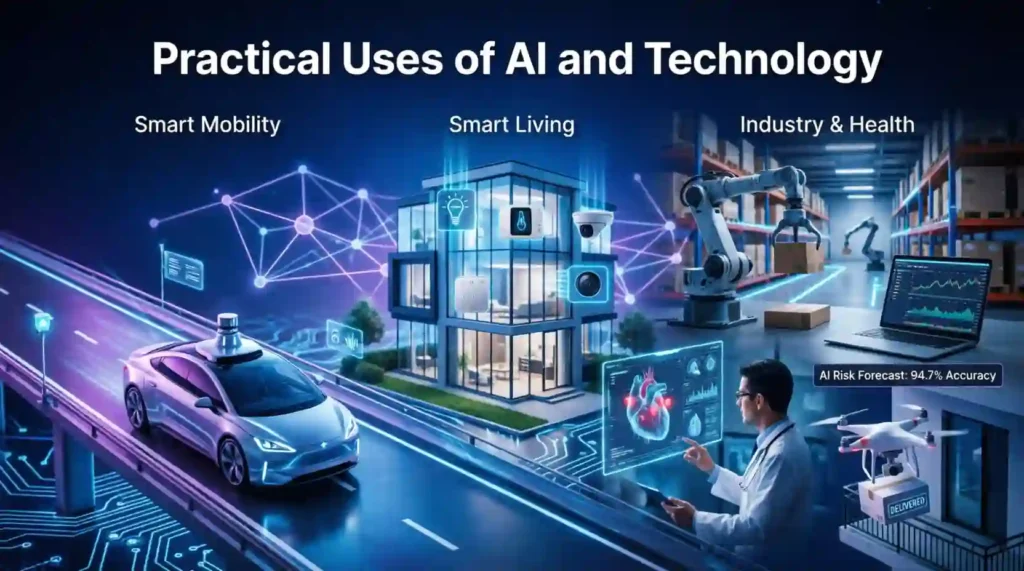
The right technology depends on the user’s goals. A student may need AI tools for research and learning, while a small business may need automation and software for managing daily operations.
- AI for Content Creation: AI tools can help users create written content, images, ideas, outlines, and other digital materials. These tools can speed up the early stages of content creation and help users explore different ideas.
- AI for Business: Businesses can use AI to support marketing, customer service, research, data analysis, and other operations.
For example, an organization may use AI to analyze customer questions and identify common problems. It can then use those insights to improve products or services.
Technology for Business Automation
Business automation can reduce the amount of manual work involved in repetitive processes.
Small businesses can automate tasks such as:
- Sending routine emails
- Organizing customer information
- Scheduling appointments
- Creating reports
- Managing repetitive administrative tasks
- Moving information between software platforms
- Following up with customers
Before automating a process, businesses should understand the existing workflow. Automating a poorly organized process can create new problems instead of solving them.
Software for Different Industries
Modern software is available for almost every industry. Businesses can choose specialized solutions based on their requirements.
For example, healthcare organizations may need software for managing patient-related information and operations. Law firms may use legal management software to organize cases, documents, and client information.
Businesses should compare software based on features, security, scalability, pricing, support, and ease of use.
How to Choose the Right Technology
With thousands of digital products available, choosing the right technology can be difficult. A structured approach can make the decision easier.
1. Identify the Problem
Start by identifying the specific problem you want technology to solve.
Instead of asking, “Which AI tool should I use?” ask what task is taking too much time or creating unnecessary work.
2. Define Your Requirements
Make a list of the features you actually need. Consider your budget, team size, technical skills, security requirements, and expected results.
This prevents you from paying for features that you may never use.
3. Compare Available Tools
Compare several options before making a decision. Look at pricing, features, user experience, integrations, customer support, and reviews.
Free tools can be useful for testing an idea, while paid solutions may provide advanced features and better support.
4. Consider Security and Privacy
Security should be an important consideration when choosing any technology.
Before uploading sensitive information to an AI tool or software platform, check how the provider handles user data. Businesses should also review access controls, privacy policies, and security features.
5. Test Before Investing
Whenever possible, test a tool before committing to a long-term plan.
A trial can help you determine whether the software actually solves your problem and whether your team can use it effectively.
AI and Technology for Small Businesses
Small businesses do not need to adopt every new technology. Instead, they should focus on tools that provide clear value.
For example, a small company may start with an AI writing tool, basic automation software, customer management software, or a productivity platform.
Automation can be particularly useful when employees spend a large amount of time completing repetitive tasks. A well-designed automation workflow can reduce manual work and improve consistency.
Businesses can also combine different technologies. For example, an automation platform can connect business software with other digital tools to move information between systems automatically.
Challenges of AI and Technology
Although modern technology provides many benefits, it also creates challenges.
- Data Privacy: AI tools and software may process large amounts of information. Businesses need to understand what data a platform collects and how that information is stored and used.
- Learning Curve: Some tools require training before employees can use them effectively. A powerful platform may not be useful if the team cannot understand how to use it.
- Cost: Technology costs can include subscriptions, implementation, training, maintenance, and upgrades. Businesses should consider the total cost rather than looking only at the monthly subscription price.
- Accuracy: AI systems can sometimes produce incorrect or incomplete information. Human review remains important, especially when technology is used for business decisions or sensitive information.
- Overdependence on Technology: Technology should support people rather than completely replace human judgment. Businesses need appropriate processes for reviewing automated results and handling unexpected situations.
Future of AI and Technology
The future of AI and technology will likely involve greater integration between artificial intelligence, automation, software, and connected devices.
AI systems are becoming more capable of understanding information and assisting with complex tasks. At the same time, automation is making it easier to connect different business processes.
For individuals and businesses, the goal should not be to follow every technology trend. Instead, focus on technologies that solve real problems, improve productivity, reduce unnecessary work, or create better experiences.
Understanding the fundamentals of AI and technology can help users make more informed decisions as new tools and innovations continue to emerge.
Choosing the Right AI and Technology Solutions
The best technology solution depends on the task, industry, budget, and goals of the user. There is no single tool that works equally well for every person or business.
Before choosing a solution, consider what you want to accomplish and how the technology will fit into your existing workflow.
For Small Business Productivity
Small businesses can use technology to reduce repetitive work and improve daily productivity.
For example, business owners can use automation to manage routine processes, organize information, and reduce manual tasks. If your business has several repetitive processes, business automation consulting can also help identify which workflows are suitable for automation.
Businesses can also start with simple automation ideas before investing in more advanced systems. This approach makes it easier to measure whether automation is actually saving time and resources.
For Content and Creative Work
AI-powered tools can support writers, marketers, designers, and other creative professionals.
These tools can help with:
- Content ideas
- Research
- Writing assistance
- Image generation
- Image editing
- Video production
- Brainstorming
- Content optimization
AI should be treated as an assistant rather than a complete replacement for human creativity. Reviewing and editing AI-generated material can help maintain quality and accuracy.
For Industry-Specific Software
Some businesses need software designed for a particular industry rather than a general productivity platform.
Healthcare organizations, for example, may require custom software that supports specific operational requirements. Similarly, law firms may benefit from software designed to organize legal information and manage daily workflows.
Before choosing industry-specific software, businesses should consider scalability, security, integrations, user requirements, and long-term maintenance.
For Video and Multimedia
Video editing software can help beginners and professionals create digital content for websites, social media, education, marketing, and other purposes.
Beginners should look for software with an easy-to-understand interface, useful editing features, compatible file formats, and reasonable system requirements.
More advanced users may need additional features such as motion graphics, color correction, audio editing, and professional export options.
How AI and Technology Can Improve Business

Buying technology is only the first step. Businesses also need a clear implementation process.
Start With One Problem
Choose one specific problem instead of changing the entire workflow at once.
For example, if employees spend several hours each week on repetitive data entry, start by looking for a solution that can reduce that workload.
Set Measurable Goals
Define what success looks like before implementing a new tool.
Your goal might be to reduce manual work, improve response times, increase productivity, or reduce operating costs.
Train Your Team
Employees need to understand how a new system works and why the business is using it.
Simple training can improve adoption and reduce mistakes during the transition.
Monitor the Results
After implementation, compare the results with your original goals.
If a technology solution does not provide the expected benefits, review the workflow and determine whether the problem is the tool, the implementation, or the process itself.
AI and Technology Trends to Watch
The technology industry continues to evolve quickly. Several areas are likely to remain important for businesses and individual users.
- AI-Powered Productivity: AI is increasingly being integrated into productivity software. Users can expect more tools that assist with writing, research, data analysis, scheduling, and other everyday tasks.
- Intelligent Automation: Automation is moving beyond simple repetitive workflows. AI can help systems understand information and make decisions within predefined processes.
- AI in Software: Many traditional software platforms are adding AI-powered features. These features can include recommendations, automated analysis, content generation, search assistance, and workflow support.
- Connected Devices: Smart devices and connected gadgets are becoming increasingly integrated with software and cloud services. This creates new opportunities for automation, monitoring, communication, and personal productivity.
- More Accessible Technology: Advanced technology is becoming easier for individuals and small businesses to access. Cloud platforms, subscription software, and AI services can reduce the need for expensive hardware or large technical teams.
Using AI and Technology Responsibly
Technology can provide significant benefits, but responsible use is important.
Users should verify important AI-generated information, protect sensitive data, respect copyright and intellectual property, and understand the limitations of automated systems.
Businesses should also create clear policies for employees who use AI tools. This can help prevent accidental disclosure of confidential information and improve the quality of AI-assisted work.
AI and Technology Checklist
Before choosing or implementing any technology, use this simple checklist:
- Identify the problem you want to solve.
- Define your budget and requirements.
- Compare different tools and software.
- Check security and privacy policies.
- Review integrations and compatibility.
- Test the solution before making a long-term commitment.
- Train users or employees when necessary.
- Track the results after implementation.
- Update software regularly.
- Review whether the technology is still meeting your needs.
Following these steps can help reduce unnecessary spending and make technology adoption more effective.
AI and Technology for Different Users
Different users can benefit from technology in different ways.
- Students: Students can use AI and digital tools for research, organization, brainstorming, learning, and productivity. However, they should verify information and follow their school’s rules regarding AI use.
- Freelancers: Freelancers can use technology to manage projects, communicate with clients, create content, track tasks, and automate repetitive administrative work.
- Entrepreneurs: Entrepreneurs can use AI, automation, and business software to reduce manual work and manage growing operations.
- Small Businesses: Small businesses can combine automation, software, and AI tools to improve productivity without building a large technical infrastructure.
- Large Organizations: Larger organizations may use advanced AI systems, machine learning, automation platforms, cloud software, and connected technologies across multiple departments.
Common Mistakes to Avoid
Adopting new technology without proper planning can create unnecessary costs and operational problems.
- Choosing Tools Without a Clear Goal: A popular tool is not necessarily the right tool for your business. Always start with a specific problem or objective.
- Ignoring Security: Businesses should never assume that every AI tool or software platform handles information safely. Review security and privacy practices before sharing sensitive information.
- Using Too Many Tools: Having too many platforms can make workflows more complicated. Whenever possible, choose tools that integrate with your existing systems.
- Skipping Employee Training: Even an excellent technology solution can fail if users do not understand how to use it. Provide clear instructions and training when needed.
- Failing to Measure Results: Technology should produce measurable value. Track relevant results such as time saved, productivity, costs, customer satisfaction, or task completion.
Frequently Asked Questions
What is AI and technology?
AI and technology refers to the use of artificial intelligence, software, automation, machine learning, digital tools, and other technologies to solve problems and improve tasks.
Why is AI and technology important for businesses?
AI and technology can help businesses improve productivity, automate repetitive processes, analyze information, support employees, and improve customer experiences.
How can small businesses use AI and technology?
Small businesses can use AI tools, automation, business software, and digital platforms to manage repetitive tasks, improve productivity, support marketing, and organize business operations.
What is the difference between AI and automation?
AI focuses on systems that can perform tasks involving capabilities such as learning, analysis, language understanding, or pattern recognition. Automation focuses on using technology to perform predefined tasks with limited manual effort. The two can also work together.
Is AI useful for small businesses?
Yes. Small businesses can use AI for tasks such as content assistance, research, customer support, data analysis, and productivity. The best use depends on the business’s specific needs.
What should I consider before choosing technology?
Consider the tool’s features, cost, security, privacy, integrations, ease of use, scalability, and ability to solve your specific problem.
Conclusion
AI and technology have become important parts of modern work and everyday life. From AI tools and machine learning to automation, software, and smart devices, these technologies can help people work more efficiently and solve problems in new ways.
The key is to choose technology based on actual needs rather than following every new trend. By identifying clear goals, comparing solutions, protecting data, and measuring results, users can get more value from their technology investments.
Whether you are a student, freelancer, entrepreneur, or small business owner, understanding AI and technology can help you make better decisions and adapt to the rapidly changing digital world.